

























































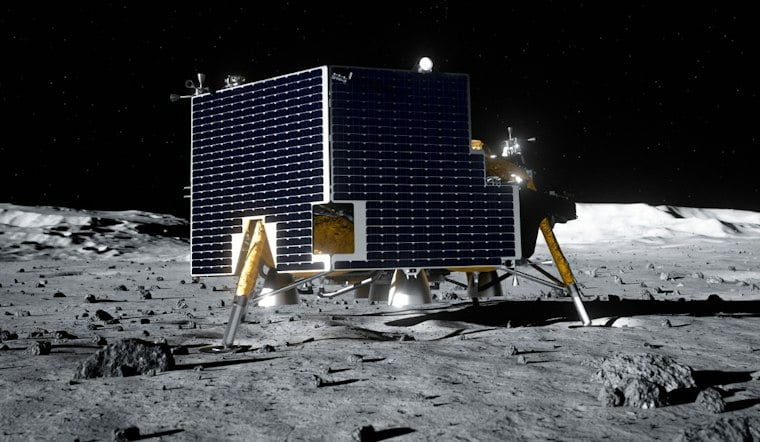
A lunar lander built right here in Pittsburgh just passed a major checkpoint on its way to the Moon. Griffin-1 has completed acceptance testing and is now rolling back into the city for a final round of preparations before it ships out to Cape Canaveral ahead of a targeted launch in late 2026.
The milestone was confirmed by Voyager Technologies, which says Griffin-1 has now returned to its Lunar Systems headquarters in Pittsburgh for final preparations ahead of the trip south. The company describes the completed acceptance testing as a critical milestone on the path to the lander's targeted late-2026 launch date. CBS News Pittsburgh was first to report that the lander is back in the city undergoing a few quick fine-tunings before its journey, according to CBS News Pittsburgh.
Once it leaves Pittsburgh, Griffin-1 heads to Florida for final launch preparations. The mission will carry 10 payloads representing six countries to the Moon's south pole, per the same Voyager release, with contributions coming from NASA, the European Space Agency and other commercial partners.
What's Riding Along to the Lunar South Pole
Griffin-1 is an infrastructure-class lander measuring nearly 15 feet wide, and it's set to carry the largest commercial payload ever delivered to the Moon to a site in the lunar South Pole region, according to Voyager's mission overview. The manifest includes five NASA payloads, Astrolab's FLIP rover and Voyager's own CubeRover, the company says. Astrolab's FLIP rover is described by The Debrief as a precursor to the company's larger FLEX rover, which is intended to support astronaut mobility on future missions.
Astrobotic's CubeRover is also integrated with Griffin for the ride, as part of what the company calls its BEACON mission. Astrobotic notes that BEACON will test communications and thermal technologies meant to help future lunar systems survive the Moon's harsh nights, according to Astrobotic. Griffin-1's own objectives are to achieve a soft landing and then operate on the lunar surface for a minimum of five Earth days, Voyager says.
Landing Site and Shifting Plans
Griffin Mission One is aiming for Nobile Crater, a site in the south pole area of the Moon, according to the Kamin Science Center. The mission has also evolved since it was first announced. Rather than carrying NASA's VIPER science rover as originally planned, the lander is now focused on demonstrating technologies that support sustained lunar exploration, per Space Explored's reporting.
Accounts of the launch timeline have varied. The Kamin Science Center has reported that the launch window shifted to summer 2026, while more recent reporting from Space Explored states the mission is currently targeted for launch in late 2026 — the timeline that matches Voyager's own statement following the completed acceptance testing. The Debrief notes that the mission is meant to demonstrate Voyager's in-house lunar mission and precision-landing capabilities ahead of future flights.
Part of a Bigger Push Back to the Moon
Griffin-1 was developed through NASA's Commercial Lunar Payload Services initiative, the same program that has backed every U.S. commercial lunar landing attempt so far. That initiative has earmarked up to $2.6 billion for missions through 2028, according to Scientific American. Those earlier CLPS-backed attempts have had mixed results: Astrobotic's own Peregrine Mission One launched in January 2024 but suffered a propulsion-system anomaly shortly after reaching space, preventing its planned lunar landing, while Firefly Aerospace's Blue Ghost later became the first fully successful touchdown, spending about two weeks running a suite of 10 NASA experiments on the surface.
Beyond the technology demonstrations, Voyager frames Griffin-1 as a step toward something bigger. Germany-based outlet Heise reports that the mission is part of a broader commercial lunar-exploration effort aimed at helping establish a lunar base by the early 2030s. For now, though, the next stop for the Pittsburgh-built lander is a short one: final tune-ups at home before the long trip to Florida and, eventually, the Moon.




