

























































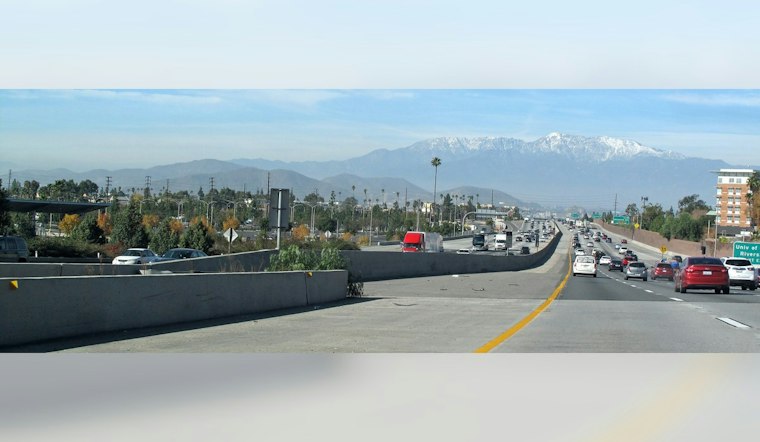
A stretch of the 71 Freeway in Pomona that has long been a bottleneck for commuters and freight trucks alike is getting a $25 million infusion of federal cash. The Los Angeles County Metropolitan Transportation Authority will use the money to complete Phase 2 of the State Route 71 Gap Closure Project, converting roughly two miles of aging four-lane expressway between Interstate 10 and Mission Boulevard into a full eight-lane freeway.
The grant comes through the Nationally Significant Multimodal Freight and Highway Projects program, known as INFRA, which the U.S. Department of Transportation announced on October 1, according to railway.supply. The outlet reports the funding will help close a two-mile gap in the corridor's high-occupancy vehicle lane system and is expected to expand intermodal container capacity along Union Pacific rail subdivisions that run nearby. Metro CEO Stephanie Wiggins said the agency is grateful for the federal support, thanking U.S. Transportation Secretary Sean Duffy as well as Sens. Alex Padilla and Adam Schiff, both California Democrats, for helping secure it, as reported by MyNewsLA.com.
What the Widening Will Actually Build
Per the same account, the project will add one carpool lane and one general-purpose lane in each direction, part of an effort that will eventually create more than 15 miles of carpool lanes along the corridor. The work is meant to improve connections between Los Angeles, Riverside and San Bernardino counties, where the 71 Freeway links the San Bernardino (10) Freeway and the Pomona (60) Freeway — two major east-west routes that carry both commuters and freight moving between the ports of Los Angeles and Long Beach and distribution centers across eastern Los Angeles County.
According to the Chino Hills official website, the physical scope includes replacing two bridge structures over railroads, building new retaining and sound walls, and installing landscaping along the widened corridor. That source also lists an existing pedestrian overcrossing among the structures slated for replacement, though Streetsblog Los Angeles has reported that the current phase was quietly scaled back to about 1.5 miles with no pedestrian component, with the Grier Street overcrossing pushed into a future segment — a discrepancy the available record does not resolve. The Chino Hills site lists a construction window running from spring 2024 to spring 2027.
A Corridor With a Crash Problem
The push for federal dollars is rooted in safety numbers. Roads & Bridges reports the targeted corridor carries a collision rate 30 percent higher than the statewide average, and Metro officials expect the improvements to reduce both collisions and travel times while supporting freight operations along the route. The INFRA program itself, according to Roads & Bridges, is aimed broadly at freight bottlenecks, highway-capacity expansion and safety fixes, with this round distributing $426.7 million across projects in 12 states.
The $25 million award adds to a funding stack that already includes a Measure M contribution. Measure M is the half-cent sales tax Los Angeles County voters approved in 2016 with 71.15 percent support, according to LA Metro, and the agency's Measure M expenditure plan programmed $248.5 million for the 71 Freeway project, per Streetsblog Los Angeles. The same report notes Metro also secured a $43 million grant from the state's Trade Corridor Enhancement Program for the corridor.
Construction Contract and Funding Pressure
On the ground, OHLA USA is carrying out an $86 million Caltrans contract tied to the Route 71 Improvement Project, with work that includes placing concrete pavement and median barriers, building retaining walls, installing new drainage systems and sound walls, and performing electrical upgrades, according to OHLA USA. Streetsblog Los Angeles has separately reported that a different section of the broader widening effort, referred to as the Northern Segment, faces a funding shortfall of up to $99 million along with the risk of significant cost increases and schedule delays — a reminder that even with new federal money flowing in, the full SR-71 overhaul remains a patchwork of grants, state funds and local tax dollars still being assembled piece by piece.




