

























































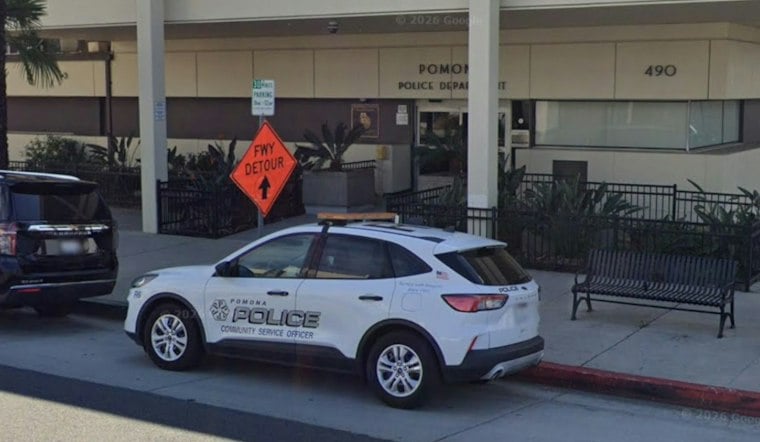
Pomona police have turned to a network of license-plate-reading cameras to go after a persistent problem along Holt Avenue: drivers cruising for sex. The stretch, long known locally as The Blade for its history of street-level sex work, has become the testing ground for an automated strategy that identifies the cars of suspected buyers, tracks their movements, and mails warnings straight to their homes.
According to the Daily Bulletin, the Pomona Police Department launched a Real-Time Information Center in June 2025 that feeds officers in the field live surveillance and data analysis, including input from Flock cameras positioned around the city. Jesus Cardenas said feedback from those cameras shows reduced activity in what had been a hotspot along the Holt corridor, per the outlet's report.
The numbers police are citing show a dramatic climb. Pomona recorded 47 prostitution-related arrests in 2024, a figure that jumped to 96 in 2025, and reached 313 as of October 13, 2026, according to Robert Sheppmann as reported by the Daily Bulletin. Trafficking arrests, by contrast, have stayed small — four in 2024, two in 2025, and one so far in 2026, per the same figures.
A New Local Indecency Law Adds Firepower
Part of the enforcement surge traces back to a local ordinance change. On July 20, 2026, the Pomona City Council voted on a local ordinance amendment and scheduled a second reading for August 3, according to city records. That strengthened law has already produced 77 arrests in 2026, per the Daily Bulletin's reporting.
The shift reflects a broader legal pivot in California. State lawmakers repealed Penal Code § 653.22, the old loitering-with-intent-to-engage-in-sex-work law, under Senate Bill 357 effective January 1, 2023, after civil rights advocates showed it was used to disproportionately target Black, Brown, and transgender women based on visual profiling, according to the Fresno Criminal Lawyer blog. In response, the state created a new tool aimed at buyers rather than sellers: Assembly Bill 379 established Penal Code § 653.25 effective January 1, 2026, making it a misdemeanor for commercial sex buyers to loiter with intent to purchase sex, with intent defined in part by vehicle behavior such as circling an area together with repeatedly beckoning, contacting or attempting to contact or stop pedestrians or motorists, or making unauthorized stops along known prostitution tracks, per the ACLU of Southern California.
That statutory framing lines up neatly with how Pomona's cameras are being used. Police use Flock license-plate readers along Holt Avenue to identify vehicles belonging to suspected sex purchasers, then send so-called john letters to the registered owners warning that their cars were caught on camera, the Daily Bulletin reports. Officers have also posted signs along the street alerting drivers to the cameras' presence.
Inside the Surveillance Setup
The Real-Time Information Center itself runs with two data analysts, a drone operator, and a dispatcher, located in Pomona. The department now operates 70 Flock cameras equipped with automatic license-plate-reader technology alongside 37 Flock Safety Condor cameras, which display live feeds using AI-integrated pan-tilt-zoom technology but do not automatically read plates themselves, according to the outlet's account.
Cardenas credited the information center and the camera network with reducing sex-crime activity overall, and said police have used the system to track a vehicle picking up a suspected human-trafficking victim in order to keep it from leaving the area, a point he made on September 21, 2026. He also said the preventative approach matters given staffing shortages, and argued the technology has affected gang activity, stabbings, and shootings, with reported incidents and calls for service for those crimes declining as a result, per his comments to the Daily Bulletin.
The buildout traces back further than this year. In 2023, Pomona police applied for state grant funding through the Board of State and Community Corrections to procure 60 Flock Safety Falcon cameras, 20 Flock Safety Condor live-feed cameras, and an ALPR-equipped mobile surveillance van, according to the Atlas of Surveillance. Hoodline previously covered an undercover sting along East Holt Avenue that charged nine men, part of the same enforcement push now being automated through cameras.
Residents Push Back on Data Sharing
Not everyone welcomes the expansion. Pomona community members have raised concerns about privacy, data-sharing, and potential misuse of the camera network, and have called for reviews of the city's Flock contract, according to the Daily Bulletin. Ivan Hernández, a director at the Pomona-based nonprofit Gente Organizada, which focuses on assisting marginalized communities including immigrant families and took part in the ICE Out of Pomona movement, said potential data sharing with federal agencies worries residents.
Those fears are rooted in recent local history. The Pomona City Council unanimously passed a resolution on April 6, 2026, prohibiting federal agencies from using city property as a staging area for civil immigration enforcement, following organizing by the ICE Out of Pomona coalition and Gente Organizada, according to The Poly Post. Pomona police currently share Flock data with 248 agencies, and that list includes no federal agency, according to the department's Flock transparency portal as cited by the Daily Bulletin.
City officials have acknowledged the scrutiny. At a police-oversight commission meeting on September 8, 2026, Eunice Russell sent 47 questions to the department regarding public concerns about its technology, per the outlet's reporting. At a council meeting on September 14, 2026, Anita Gutierrez said the city attorney was reviewing the Flock contract for data privacy issues and that the city would initiate any changes found to be needed.
State law already places some guardrails on the system. California Civil Code § 1798.90.5, enacted under Senate Bill 34 in 2016, requires agencies operating automated license-plate readers to maintain a publicly available privacy policy and limits data sharing exclusively to public agencies, according to SignalData. Flock concerns have also arisen in West Hollywood.



