

























































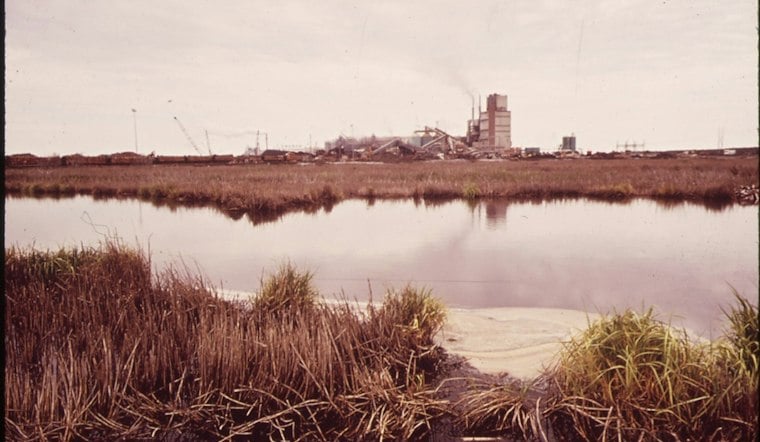
Washington state regulators issued a notice of violation against Port Townsend Paper Company over two untreated-wastewater releases to Puget Sound in November 2025. The volume of the second release remains disputed: the mill reported about 150 gallons, while two former workers say substantially more escaped. The available accounts do not establish that the company concealed the spill. The notice adds to a record of water-quality penalties and comes as the mill faces scrutiny following a deadly industrial accident elsewhere in Washington.
The Washington Department of Ecology confirmed that Port Townsend Paper breached its clean-water permit twice that November, according to The Seattle Times. Ecology spokesperson Andy Wineke said the agency could impose financial penalties, require corrective action, or do both, and has up to two years from the spill dates to act.
The first release occurred on the morning of November 7, 2025, when the mill’s main and backup pumps failed. An Ecology notice cited by the Seattle Times estimated that about 600 gallons of untreated wastewater entered Port Townsend Bay. On November 20, a hole in the mill’s operations allowed untreated wastewater to pass into an unmonitored 24-inch pipe and flow into Puget Sound.
Workers Dispute the Reported Volume
For the November 20 incident, mill official Micheal Clea reported a flow of about 6 gallons per minute for 25 minutes, or roughly 150 gallons, according to the Seattle Times. The company said the leak was found at about 8:41 p.m., workers stopped the flow within minutes and the hole was sealed by early the next morning. The outlet reported that Ecology accepted the company’s estimate without an independent follow-up investigation.
John Tippins, a former employee who said he was among the first workers to respond, disputed both the reported flow rate and duration, telling the outlet that the pipe was flowing much faster and the leak likely continued for hours. Tippins said the company fired him afterward. Port Townsend Paper said he was dismissed for unrelated performance issues and that his account did not change the company’s estimate. Tippins is seeking whistleblower protections, and the Department of Ecology and Washington Attorney General’s office are investigating the spill’s size and scope.
Ian Dale, another former worker, told the outlet he saw pulp and fiber along the shoreline when he worked the mill’s 5 a.m. shift on November 21, and described the seawater as appearing to have sludge mixed through it. Dale estimated the spill was about 100 times larger than the company’s 150-gallon figure. He said the mill fired him a few days later, citing poor attendance and his decision to speak out. Dale, who lives in Bremerton, had worked at the mill on and off for about a year and has since found other work.
Review of Images Points to Uncertainty
The Seattle Times reported that five experts who reviewed photos and video considered a spill larger than 150 gallons likely, with some suggesting it could have been hundreds of times larger. Regulators did not test the water after the release or determine whether fish or wildlife were harmed. Wastewater can carry harmful particles and fibers and consume oxygen in water, potentially harming aquatic life. Mill official Randy Coté said the company reviewed the incident three times and concluded it was limited in magnitude and posed no significant environmental risk; he said the company reported it accurately and would continue working with Ecology.
A Pattern of Penalties Stretches Back Years
The November 2025 spills are not isolated. The Department of Ecology fined Port Townsend Paper $734,000 in September 2026 after an October 2025 inspection found 170 days of wastewater treatment non-compliance in the mill's 30-acre aerated stabilization basin, a failure that culminated in April 2026 spills of 9,000 gallons of corrosive black liquor and six separate permit discharge violations, according to the Washington State Department of Ecology. That penalty marks the fifth water-quality fine the state has levied against the mill since 2021. A year earlier, in September 2025, Ecology had already penalized the company $20,000 for two separate pipe leaks that discharged 1,000 gallons of steam condensate and 114,000 gallons of untreated wastewater into the bay. Port Townsend Paper officials have indicated they intend to appeal the $734,000 fine to the state Pollution Control Hearings Board; the company had 30 days to pay or appeal the fine.
What the Compliance and Monitoring Records Show
Ecology says it issued Port Townsend Paper two penalties in 2023 for water-quality violations that occurred in 2022, separate from the November 2025 spills, according to the Washington State Department of Ecology. The agency’s fact sheet identifies the mill’s NPDES permit as WA0000922, effective June 1, 2025. The verified information here does not establish the permit’s specific reporting, monitoring or follow-up provisions, so those requirements cannot be inferred from the permit number and effective date alone. For a point of comparison on local monitoring, the Jefferson County Clean Water District and Jefferson County Public Health report that the county health department did not conduct bacteria monitoring in marine water in 2023. That pre-spill record cannot establish water conditions after the November 2025 release; the spill’s volume and potential effects on aquatic life remain unresolved in the information described above.
In an official response published in October 2026, the company said it has spent more than $8 million on environmental upgrades since 2022 and plans roughly $11 million in total wastewater system improvements, including lagoon dredging set to begin this fall, per Port Townsend Paper Company. The company says it has begun using mill-owned dredging equipment and rebuilt its clarifier. The mill employs about 300 workers and produces roughly 1,000 tons per day, making it one of Jefferson County's largest private employers and cardboard recyclers.
Shadow of the Longview Disaster
Port Townsend Paper CEO Rob Kreizenbeck wrote that he believes his mill should be judged independently of a catastrophic accident at a Longview, Washington paper mill. On May 26, 2026, a storage tank containing highly corrosive white liquor collapsed at the Nippon Dynawave Packaging mill there, releasing roughly 900,000 gallons and killing 11 workers and injuring eight others in what AP News described as the state's deadliest industrial disaster since 1930. A federal Chemical Safety Board report released in August 2026 found that an inspection contractor had warned Nippon Dynawave as early as July 2025 that the tank was not fit for continued service due to severe shell thinning, yet the company made no internal repairs before it failed.
That disaster prompted the Washington State Department of Labor & Industries to open workplace safety inspections at both Port Townsend Paper and Smurfit Westrock in July 2026 to evaluate industrial equipment safety, according to Packaging Dive. That inspection effort ran alongside a separate criminal inquiry by the Washington Attorney General's office into whether criminal activity contributed to the Nippon Dynawave disaster in Longview. Port Townsend Paper has been owned since October 2022 by Atlas Holdings LLC, a Connecticut-based private equity firm that operates more than 25 industrial and manufacturing companies and entered the paper industry in 2002. As state officials and lawmakers look for ways to strengthen oversight of major industries, the dispute over what actually spilled into Port Townsend Bay last November remains unresolved.





