

























































Jake Hutzler has a commute most people would never dream up: strap into a paramotor, lay out his wing on a road outside his apartment complex, take off, glide over a highway and a water tower for about 20 minutes at 35 mph, then radio the very colleagues he is about to join for permission to land. The 28-year-old air traffic controller has been doing this once a week since June, weather allowing, turning an ordinary workday into an aerial routine that folds his hobby directly into his job.
Hutzler calls the tower before he ever takes off, letting his coworkers know he is airborne, and he keeps them updated on his location and altitude the entire flight, according to Associated Press, via KTAR. That coordination matters because, as Hutzler put it, he is very small and does not show up on radar. Once he reaches the airport, he waits for permission to land on the ramp before packing up and beginning his shift.
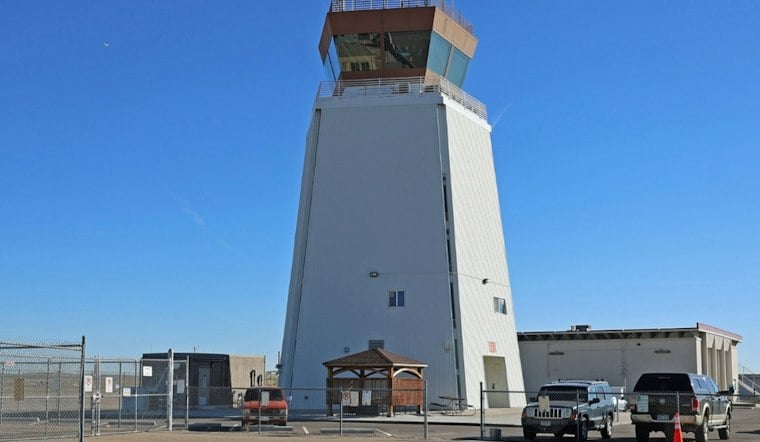
Pueblo Memorial Airport is no quiet backwater strip. It sits inside Class D controlled airspace at an elevation of 4,729 feet, with three hard-surface runways and a tower staffed daily from 6 a.m. to 10 p.m., according to the Federal Aviation Administration. That altitude thins the air enough to affect how well an ultralight craft like Hutzler's can climb, one more variable he has to account for before he ever leaves the ground.
From Flight School Dropout to Paramotor Instructor
Hutzler's path to the sky started long before Pueblo. In college he logged about 20 hours of flight instruction toward a private pilot's license, but the costs piled up and he stopped, per the Associated Press, via KTAR. A viral video of someone flying a paramotor to a fast-food restaurant pushed him toward the sport instead, and he trained in Florida in 2021 before eventually taking his controller job in Pueblo.
His fascination with flight goes back even further, to childhood trips airborne with his grandfather, a pilot who regularly took him up in a small four-seat plane, the article notes. Hutzler went on to become a paramotor instructor himself, and he even trained the woman he later married. The couple now has a 2.5-year-old daughter, and Hutzler started his air traffic control career earlier this year.
Paramotors are also known as powered paragliders, and flying one requires no license at all. They fall instead under federal ultralight-vehicle rules that limit them to daytime operation and require pilots to steer clear of congested cities and towns. Under Federal Aviation Regulations Part 103, a powered ultralight is legally defined as a single-occupant craft built strictly for recreation, weighing under 254 pounds empty with no more than five gallons of fuel capacity, according to the Experimental Aircraft Association. The category caps top speed at 55 knots and bars ultralights from entering controlled airport airspace without prior clearance from air traffic control, with ultralights required to yield right-of-way to all powered aircraft.
Coordinating With the Tower Before Landing
That last rule is exactly why Hutzler's commute only works because of where he works. Before his first paramotor flight to the job last June, he talked the idea over with his manager, and the two of them set up a system to guarantee two-way radio communication the moment he entered the tower's airspace. Being an insider at the facility he is flying into lets him satisfy safety requirements that would normally be difficult for an uncertified ultralight pilot to meet on their own.
The FAA created this minimal regulatory lane more than four decades ago, establishing Part 103 on October 4, 1982, to exempt lightweight sport aircraft from airworthiness certificates, registration, and pilot licensing altogether, the Experimental Aircraft Association notes. The rules also set operating limits and right-of-way requirements. For additional structure, the United States Powered Paragliding Association has pilot ratings for fliers.
Weather, Not Traffic, Dictates His Schedule
Unlike a car commute, Hutzler's depends entirely on the sky cooperating. Wind above roughly 10 mph (16 kph) keeps him grounded, and sun-heated ground can generate updrafts that make flights extremely bumpy. You Can Fly PPG recommends calm conditions up to 8 mph and describes the safest windows as the two hours after sunrise and the two hours before sunset to avoid thermal turbulence from mid-day ground heating. Hutzler has kept flying to work when conditions allow, even though, by his own account, setup and packing make the trip slightly longer than simply driving.
The quirky commute lands amid a tighter national conversation about who is staffing America's control towers in the first place. The FAA hired 2,028 air traffic controller trainees in fiscal year 2025, but 1,460 controllers left through retirement or attrition over the same stretch, for a net gain of just 568 nationwide, Hoodline previously reported. Closer to home, Pueblo Community College received a $471,423 state grant in late 2025 to launch an Aviation Maintenance Technician program aimed at building out the region's aerospace workforce, with the program specifically targeting former coal industry workers and veterans.
For Hutzler, the appeal comes down to something simpler than policy or paychecks. He has said paramotoring gives him a view almost nobody gets to experience, a perk he gets to collect on his own terms, once a week, somewhere over the fields and highway outside Pueblo, before trading the open sky for a chair inside the tower, after its controllers have given him the OK to land.





