

























































The Department of War has awarded Raytheon a $247.1 million sole-source contract to keep building, upgrading, and overhauling the Phalanx close-in weapon system, extending production and hardware deliveries across Navy ships, Army bases, and SeaRAM units through September 2030. The deal, announced Tuesday, ties together naval and land-based air-defense procurement under a single contract vehicle.
A Contract Spanning Sea and Land
According to Defence Blog, the Naval Air Systems Command issued the award, which covers overhaul work and new hardware for Navy surface ships as well as Army ground installations that rely on the system's land-based variant. The same outlet, which first reported the deal on September 30, notes that the contract reflects ongoing, multi-branch reliance on the Phalanx family across both maritime and land domains. As Defence Blog also explains, the Navy leans on shipboard Phalanx mounts and SeaRAM missile launchers to intercept anti-ship cruise missiles and littoral surface threats, while the Army depends on the Land-Based Phalanx Weapon System, known as Centurion C-RAM, to shield bases from incoming rockets, artillery, and mortar fire.
This is not the first big check written for the Phalanx line in recent memory. Back in September 2025, Raytheon secured a separate $205 million Navy contract for continued production, upgrades, and overhauls, with manufacturing and overhaul work centered at facilities in Louisville, Kentucky, through 2029, according to a statement carried by PR Newswire. That same release confirms Phalanx systems are deployed on every surface combatant ship class in the U.S. Navy and serve in the fleets of 24 foreign allied nations.
The Army, too, has been locking in its own long-term commitments. In June 2025, the U.S. Army Contracting Command awarded Raytheon a $279.2 million contract to provide functional management support and life-cycle sustainment for the Land-Based Phalanx Weapon System through July 2030, according to MILMAG. That award illustrates the Army's distinct financial commitment to maintaining its ground-based counter-rocket, artillery, and mortar infrastructure separate from the Navy's shipboard needs.
Why the Urgency Now
Recent real-world engagements in the Red Sea have sharpened the focus on terminal point defense. During combat operations on January 30, 2024, the Arleigh Burke-class destroyer USS Gravely deployed its 20mm Phalanx CIWS to shoot down an incoming Houthi anti-ship cruise missile that had penetrated outer defense layers and closed to within one nautical mile of the ship, as reported by Navy Times. The incident offered real-world proof of the system functioning as a warship's absolute last line of defense against threats that slip past everything else.
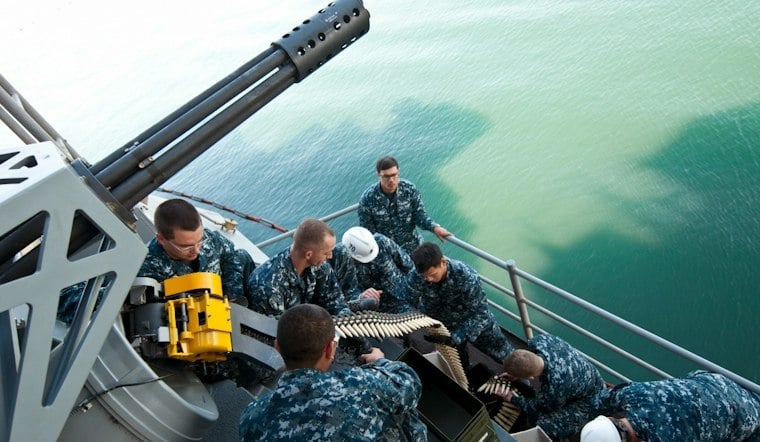
The hardware behind that moment is built around a 20mm M61A1 six-barrel Vulcan Gatling gun capable of firing at dual rates of 3,000 or 4,500 rounds per minute, up to 75 rounds per second, guided by integrated Ku-band search and tracking radars, per technical documentation from manufacturer General Dynamics Ordnance and Tactical Systems. That rate of fire does not come cheap. Pentagon budget data analyzed by TWZ in March 2024 found that the Navy's primary operational round, the Mk 244 Mod 0 Enhanced Lethality Cartridge with its tungsten penetrator, costs $45.84 apiece, meaning a typical two-second, 150-round burst runs roughly $6,876 in ammunition alone.
Different Battlefields, Different Bullets
The Army's ground-based units fire something entirely different. Official U.S. Army capability documentation published in 2026 notes that land-based Phalanx units use specialized 20mm M940 Multipurpose Tracer-Self Destruct ammunition designed to detonate automatically after roughly 2,000 meters in flight, preventing unexploded rounds from striking friendly troops or civilian areas on the ground. The distinction matters: the Navy's tungsten penetrators are built for maximum kinetic punch against armored anti-ship missiles, while the Army's self-destructing rounds exist specifically to limit collateral damage over inhabited land.
Raytheon's product line also extends beyond the Gatling gun itself. As Naval News explained in May, SeaRAM, designated Mk 15 Mod 31, swaps the Phalanx 20mm Gatling gun for an 11-cell Rolling Airframe Missile launcher while keeping the same radar and sensor suite, enabling standalone missile defense out to 9 kilometers without requiring integration into a ship's main combat system. That modularity has found buyers overseas: in May 2026, Mitsubishi Heavy Industries selected Raytheon to supply SeaRAM systems for Australia's SEA 3000 program, equipping 11 new Upgraded Mogami-class frigates for the Royal Australian Navy, with initial deliveries beginning in late 2028.
The ability to offer SeaRAM as a bolt-on replacement for the 20mm gun mount gives Raytheon a unified supply chain spanning both gun-based and missile-based terminal defenses, a setup that appeals to domestic military branches and international partners alike. With the new $247.1 million award pushing production and overhaul commitments out to September 2030, the Phalanx family looks set to remain the Pentagon's go-to answer for last-ditch defense against missiles, rockets, and mortar fire for years to come.





