

























































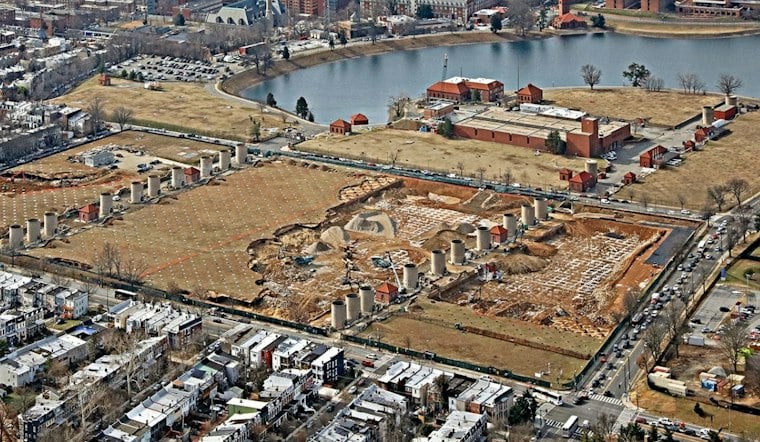
The company behind a long-planned medical campus at Washington's Reservoir District says that plan is no longer workable, and it wants permission to fill roughly 1 million square feet of approved healthcare space with something else entirely — housing, offices, a hotel, even a college building. Trammell Crow Company has filed a request to modify the 2018 approval governing two undeveloped parcels at the former McMillan Sand Filtration Site, a signal that one of the District's marquee redevelopment sites is still being reshaped nearly a decade after it won zoning sign-off.
A Medical Campus That Never Found Its Tenant
As reported by UrbanTurf, the 2018 approval allows healthcare uses only on Parcel 1 and Parcel 3, with Parcel 1 approved for up to 875,000 square feet of building and Parcel 3 approved for up to 173,000 square feet. The plan hit a wall in 2022, the outlet reports, when Parcel 1's anchor healthcare tenant terminated its lease — and per the filing, no replacement tenant has stepped in since. Trammell Crow told regulators the approved plan is no longer workable, citing surging construction and interest rates along with a broader shift toward smaller, more dispersed medical facilities as obstacles that undercut the original vision, according to the same filing.
Trammell Crow's new proposal would open the two parcels to medical, college and university, office, institutional, entertainment, lodging and residential uses, per the UrbanTurf report. The company's filing explicitly excludes single-family homes and flats as options, and it has agreed to continue banning nightclubs, cannabis dispensaries and liquor stores as potential tenants on the site. Any residential development on either parcel would still have to set aside 20 percent of that space as affordable housing, the filing states, while Parcel 1 must retain at least 15,000 square feet of retail and Parcel 3 must retain 3,000 square feet.
Two Tracks for Parcel 1's Redesign
Per the filing described by UrbanTurf, Parcel 1 has a two-track design process ahead of it. A design that stays close to the already-approved building could be tweaked without full Zoning Commission review, but a full redesign would require a pass through the Historic Preservation Review Board and would trigger a Zoning Administrator referral to the commission itself. Once that referral happens, the commission has 45 days to weigh in, and the outlet notes a full redesign could involve multiple buildings rather than a single structure. Trammell Crow is not asking for any added height, density or lot coverage beyond what's already approved, according to the filing, and the company says it plans to present its modification request to the Zoning Commission in the coming months.
The Reservoir District itself is a 25-acre mixed-use redevelopment at the historic McMillan Sand Filtration Site along North Capitol Street, built by Jair Lynch Real Estate Partners, Trammell Crow Company and EYA under the banner of Vision McMillan Partners — a joint venture UrbanTurf describes as having bought the McMillan land for $17.3 million in 2022. While Trammell Crow has handled the stalled medical component, the rest of the site has kept moving. EYA unveiled 146 for-sale townhomes in summer 2026, and the Reservoir District park — a 6.2-acre green space along with a recreation center and aquatic center — opened in 2024.
Housing and Grocery Plans Elsewhere on the Site
Jair Lynch's portion of the project is further along. The company's first residential phase calls for roughly 324 apartments above a grocery store and about 22,000 square feet of neighborhood retail, while its second phase is planned to add roughly 266 more apartments, including 141 affordable senior units for residents 55 and older, and may include a grocery store of its own, per Jair Lynch. Trammell Crow's share of the project, by contrast, is the piece that has been waiting on a new direction since its intended anchor tenant walked away.
The developer's pivot is not without precedent on this same site. Jair Lynch previously floated changes to its own Parcel 4 plans, proposing to shift from a 280-unit building split between 196 market-rate apartments and 85 affordable senior units toward a design open to residents of all ages, with the senior housing component relocated to Parcel 2, according to a separate UrbanTurf report. That revision would keep grocery and retail space while also allowing residential use on the ground floor, with Jair Lynch saying the goal was to create additional housing while still preserving space for neighborhood-serving grocery and retail tenants. The earlier overall vision for the privately developed portion of McMillan, as reported by DCist, called for 146 for-sale townhomes and 467 rental apartments alongside a one-million-square-foot office space earmarked for healthcare facilities — the very component Trammell Crow is now trying to unwind.
A Softening Office Market Backdrop
Trammell Crow's request arrives as Washington's office market has been slowly stabilizing after a rough start to the year. The market recorded 234,546 square feet of negative absorption in the first quarter of 2026, with office-to-residential conversions contributing to the inventory reduction and no new office projects actively under construction citywide, according to a Cresa market report. Roughly 300 sublease spaces totaling more than 3 million square feet were sitting available across the District at that point, the report found. By the third quarter, conditions had turned: a CBRE report found 360,154 square feet of positive absorption drove a 40-basis-point decline in overall vacancy, with Prime office vacancy at 8.3 percent and Class A buildings absorbing 218,400 square feet during the quarter. Private-sector leasing was on pace to exceed its 10-year historical average, CBRE noted, even as federal government leasing remained well below historical norms.
None of that directly explains Trammell Crow's decision to abandon a single-use medical campus for a broader mix of uses, but it underscores the kind of office and development landscape the company is navigating as it reworks its plans. For now, the fate of the two parcels rests on a filing that proposes options rather than a finished design — and on a Zoning Commission review that, per the company's own timeline, is still months away.


