

























































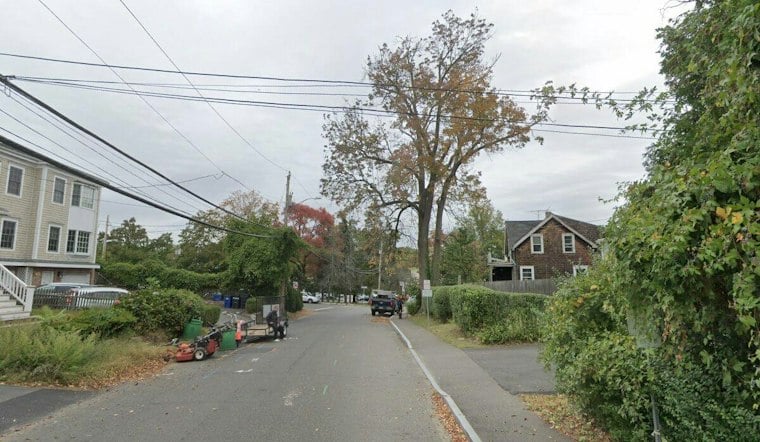
A 29-year-old Ridgewood, New York man was nearly run over by his own car on Edgewood Avenue after he shifted it into neutral in an apparent attempt to keep police from towing it, according to Greenwich police. Anthony A. Vargas was arrested on October 1 and now faces a string of misdemeanor charges stemming from the bizarre encounter, which began with officers responding to a report of a man asleep in a parked vehicle.
According to Greenwich Free Press, officers were called to Edgewood Avenue after someone reported seeing a man sleeping in a parked vehicle with his pants pulled down. Police say that when they arrived, Vargas was indeed asleep in the vehicle, but he was not exposed. The car itself, however, became the bigger problem: it was parked on the public roadway, unregistered, and displaying the wrong plates, police said.
Officers also determined that Vargas's New York driver's license was suspended, per the same account. With the vehicle unregistered and the driver unlicensed, police told Vargas the car would be towed — a routine outcome for a vehicle in that condition on a Greenwich street.
A Tow Order Meets Defiance
Rather than let the tow proceed, Vargas defied officers' orders not to move the vehicle, according to police. He shifted the car into neutral, and without setting the parking brake or putting it in park after exiting, the vehicle began rolling down the hill and partly into a private parking lot, police said. The unoccupied car then rolled backward toward Vargas, nearly running him over, according to the report.
What started with officers responding to a report of a man asleep in a parked vehicle escalated quickly once the vehicle began moving on its own. Connecticut classifies interfering with an officer as a Class A misdemeanor under state law, carrying penalties of up to one year in prison, three years of probation, and a maximum $2,000 fine, according to Justia. That same statute can escalate to a Class D felony, punishable by up to five years in prison, if the conduct causes serious physical injury or death, though no such injury has been reported in this case.
Charges Pile Up for Greenwich Driver
Vargas was ultimately charged with interfering with a police investigation, reckless driving, operating without a license, misuse of registration, and operating an unregistered motor vehicle, according to the Greenwich Free Press account relayed by police. Connecticut treats reckless driving as a criminal misdemeanor rather than a simple traffic ticket — a first offense can bring up to 30 days in jail, a fine of $100 to $300, and a mandatory 30- to 90-day license suspension, per Allan F. Friedman Law.
The misuse-of-registration charge carries its own exposure. Improper use of license plates under state law is an unclassified misdemeanor punishable by up to 30 days in jail and fines as high as $500, according to the Law Offices of Mark Sherman. Separately, operating an unregistered vehicle on a public road is a motor vehicle infraction carrying fines between $150 and $300 for a first offense, per the Sills Law Firm, while driving without a valid license is a statutory violation that can trigger administrative license suspensions through the state's motor vehicle agency, according to Allan F. Friedman Law.
Released on a $105 Bond
Vargas was released after posting the required minimum surety bond of $105 — 7% of a $1,500 surety bond. That arrangement reflects Connecticut Practice Book § 38-8, which state Superior Court judges updated effective January 1, 2024, making defendants with surety bonds up to $50,000 automatically eligible to post 7% in cash directly to police or court clerks rather than hiring a commercial bail bondsman, according to Inside Investigator's coverage of the 2024 bail reform.
He was assigned a court date of October 14 at Stamford Superior Court. All misdemeanor and traffic cases originating in Greenwich are adjudicated there, at 123 Hoyt Street, which serves as Geographical Area No. 1 covering lower Fairfield County municipalities including Greenwich, Stamford, and Darien, according to the Connecticut Judicial Branch.
Towing Rules Behind the Encounter
The incident also touches on Connecticut's regulatory framework for police-ordered tows. State Department of Motor Vehicles regulations governing non-consensual tows cap allowable towing rates and require wrecker operators to photograph vehicles before removal. Last year, the state legislature passed Substitute House Bill 7162, creating a Police-Ordered Towing Council and standardizing consumer protections for non-consensual vehicle removals statewide, according to the Connecticut General Assembly.
In Greenwich, municipal fines are paid in person at town offices, while towing and storage fees are typically handled directly with the towing company. It remains unclear whether the rolling vehicle caused any damage once it entered the private parking lot, or how the case will ultimately be resolved in court.





