

























































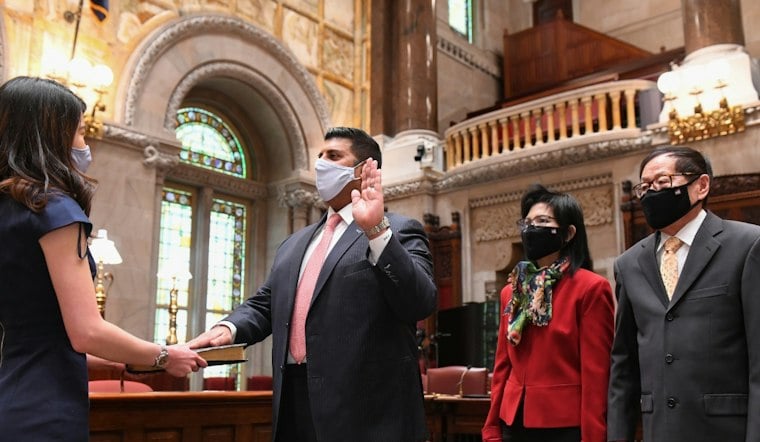
State Sen. Jeremy Cooney has introduced legislation that would make health coverage free for New York children statewide, stripping away premiums, copays and deductibles without regard to how much their parents earn. The Rochester Democrat, who represents the 56th State Senate District, says the goal is simple: no family should have to choose between a child's doctor visit and groceries, rent or utilities.
Under the proposal, children already enrolled in or eligible for Medicaid would keep that coverage, while every other New York-resident child could sign up for a Child Health Plus plan with no copays or deductibles, according to WHEC. Cooney told the station the coverage would not be income dependent, and that children would be completely covered under the legislation as long as they are New York residents, even if their parents keep separate employer-sponsored insurance. News outlets differ on the exact age cutoff: WHEC reported the bill would cover children from birth to age 19, while RochesterFirst reported it would run from birth through age 18.
The legislation would also set a new provider reimbursement rate higher than the current Medicaid rate, Cooney told WHEC, an effort aimed at keeping doctors willing to take on new patients under the program. The plan would work within the existing federal Medicaid framework while opening Child Health Plus to kids regardless of household income, the same RochesterFirst report notes.
Why Cooney Says the Gap Matters Now
Cooney has pointed to New York insurers' request for an average 21 percent premium increase as part of the backdrop driving the bill, per RochesterFirst's reporting. He has also cited a figure of more than 113,000 New York children from birth to age 18 who lack consistent access to care, though the state Department of Health's own estimate, listed on its website, puts the number of uninsured children under 19 at 343,000, of whom 311,000 are described as already eligible for publicly subsidized coverage. The two figures were not reconciled in available reporting.
Cooney argues that catching chronic conditions early saves money down the line. “A lot of the chronic diseases, asthma, diabetes, heart conditions, can be detected in adolescence and we can prevent that from exacerbating and getting worse,” he told WHEC. He has also said that when coverage becomes unaffordable, preventive care is often the first thing families cut.
No Price Tag Yet
What the program would actually cost the state remains an open question. Cooney told WHEC the state was still calculating the premium costs it would need to absorb and expected more detail before the legislative session begins in January. Separately, Finger Lakes1 reported that the bill's sponsor memo does not provide a cost estimate at all, instead listing the fiscal implications as undetermined.
WHEC also reported that insurance experts and economists it contacted had not yet reviewed the proposal because it was so new, leaving independent analysis of the plan's feasibility still to come. Cooney has said he believes New York would be the first state in the nation to establish this kind of universal child health coverage, according to the same WHEC report.
The Stakes for Uninsured Kids
Research cited in connection with the bill, attributed to the American Academy of Pediatrics, found uninsured children are five times more likely to have unmet medical needs and four times more likely to miss preventive visits such as checkups, screenings and immunizations, and that they are significantly more likely to experience avoidable hospitalizations. Consistent coverage, by contrast, has been linked to better academic performance, higher graduation rates and stronger long-term financial security for kids, according to the bill's supporting research.
The push comes amid a broader national slide in children's public coverage. Nationally, Medicaid and CHIP enrollment fell by 5.1 million people, or 6 percent, from June 2025 through June 2026, according to KFF's enrollment tracker. Child enrollment specifically dropped in 49 states and the District of Columbia over that same period, and has fallen by 960,000, or 3 percent, since February 2020 in the states with complete age data, though KFF notes the June 2026 figures remain preliminary and subject to revision.
At the state level, the Department of Health has estimated that about half of New York children eligible for publicly subsidized coverage qualify for Medicaid, with the rest eligible for Child Health Plus, per the agency's own data. Whether Cooney's bill can close the remaining gap, and at what cost to the state, is likely to become clearer as lawmakers head toward the new legislative session in January.





