

























































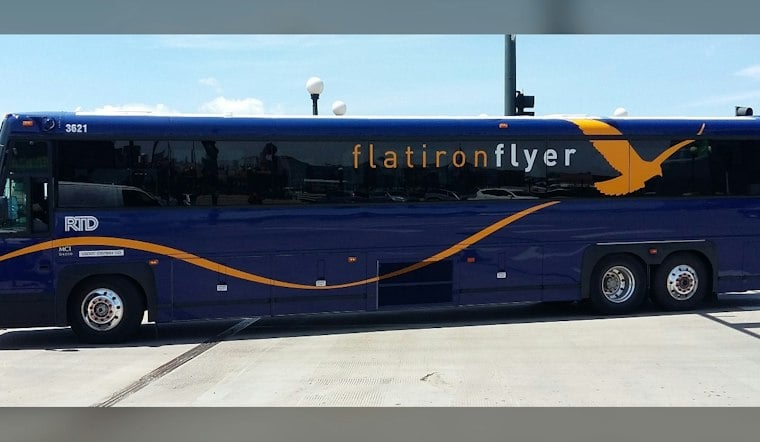
Bus riders across metro Denver and Boulder are being told to expect more trips, longer service windows and a beefed-up Flatiron Flyer starting in 2027, as the Regional Transportation District moves to put a $44 million state grant to work. The money is meant to touch some of the region's busiest corridors, from East Evans Avenue to Sheridan Boulevard, while also adding capacity on the commuter route that links Denver and Boulder along U.S. 36.
According to The Denver Post, RTD will use the $44 million grant to increase transit service for metro Denver residents and visitors, with plans to add more trips on routes along East Evans Avenue, Buckley Road, Alameda Avenue, South Downing Street and University Boulevard. The agency also plans more frequent service on routes along West 38th Avenue, Hampden Avenue, Monaco Parkway, Wadsworth Boulevard and Havana Street, while extending service hours on Broadway and Mississippi Avenue routes, per the same report. RTD estimates the grant will generate 3.8 million additional transit rides in 2027.
The plan also calls for expanded or new service along Sheridan Boulevard, between Central Park and the Anschutz Medical Campus, and along 72nd Avenue and South Kipling Street, the Post reports. On the Flatiron Flyer, which connects Denver and Boulder along U.S. 36 and also links Boulder to Denver International Airport, RTD intends to increase trip frequency.
State Officials Frame the Investment as a Reliability Fix
Colorado Department of Transportation Executive Director Shoshana Lew called the Flatiron Flyer one of the Front Range's most heavily used commuter routes, according to the Post's account. Lew said more frequent service, better connections and expanded hours will make transit more dependable for work, school, appointments and entertainment, and added that the investments advance state goals of expanding transportation choices, reducing congestion and improving air quality.
Lew also tied the expansion to the Flatiron Flyer's origins, noting it was part of the state's commitment to expand transit options and improve air quality when U.S. 36 was widened, per the same report. State and agency leaders said in a news release that the grant will increase route frequency and restore or expand service across the network.
A Separate $9.3 Million Grant Already Reshaped Bus Routes This Year
The $44 million figure comes from a CDOT announcement describing a grant to RTD for more frequent transit, longer service hours and new or expanded routes, according to codot.gov. That figure is distinct from an earlier, separately documented $9.3 million grant that RTD and the Colorado Clean Transit Enterprise announced on May 7, 2026, to increase frequency and launch new bus service. That earlier funding, detailed by RTD, paid for frequency increases or pattern revisions on Routes 1E/44, 37, LD3/287, the 16th Street FreeRide and 21E, plus an expansion of Route 19, the reinstatement of Routes 53 and 80, and a brand-new route connecting Longmont directly to Denver International Airport.
RTD requested that the $9.3 million award be expedited specifically to support the agency's June 7, 2026, service changes, the transit agency said. Mass Transit reported that funding was authorized under Senate Bill 24-230 and marked the first award under a new formula grant program.
Oil and Gas Fees Fund the Clean Transit Enterprise
Both rounds of funding trace back to state law: the Clean Transit Enterprise was created in 2021 under Senate Bill 21-260, while Senate Bill 24-230 establishes the clean-transit production fee. Under that law, the Clean Transit Enterprise must impose a production fee for clean transit paid quarterly by every oil and gas producer operating in Colorado, according to the Colorado General Assembly. RTD officials have said the funding, by law, is dedicated to the expansion and restoration of transit services.
The push for more service follows years of reduced bus schedules tied to pandemic-era ridership drops and workforce gaps. RTD previously set a target of restoring service to 85% of pre-pandemic levels by 2027, according to Boulder Reporting Lab, which also reported that the agency has cited a shortage of drivers as the reason it hadn't restored more service sooner. Earlier reporting found ridership had recovered to only about 53% of pre-pandemic levels across the system, though those figures reflect conditions reported in earlier coverage rather than current 2026 ridership.
Boulder-area riders have already seen pieces of this expansion take shape. RTD previously planned to increase service on the AB1 and AB2 routes between Boulder and Denver International Airport, add two eastbound daily trips on the FF5 route, and eventually boost BOLT frequency from every 30 minutes to every 15 minutes while building a bus layover facility in Lafayette, per Boulder Reporting Lab's reporting. A planned FF4 route was also set to run between Boulder Junction and Denver's Civic Center Station, with stops at Table Mesa, McCaslin, Flatiron, Broomfield and Sheridan.


