

























































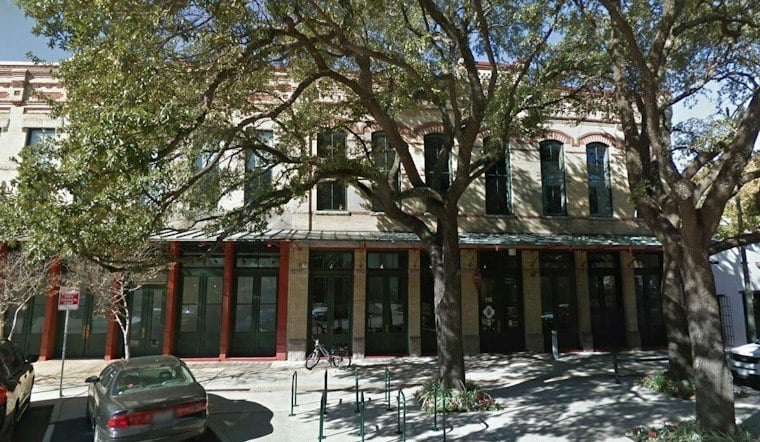
A surface parking lot tucked behind San Antonio's city hall is on track to become a small pocket park and outdoor podcasting studio, after the city's Historic and Design Review Commission signed off on design plans for the site at 115 Plaza de Armas. The project, known as the Calder Alley “Secret Garden” TVSA Project, would replace what's currently described as an urban heat island with a landscaped gathering space wedged between historic structures near the Spanish Governor's Palace.
The studio itself is planned as a small structure finished with brick veneer, aluminum-clad wood windows, cast stone window sills, metal screening and a steel entrance canopy, according to San Antonio Report, which first reported the commission's vote. The design also calls for a living wall of plants and metal screening around an existing structure, plus utility screening on the southwest corner, per the application. The site sits within reach of Dolorosa Street or West Commerce Street, near Calder Alley and San Pedro Creek Culture Park.
Who's Behind the Design
San Antonio firm Beaty Palmer Architects, through architect Blagica Jovanova, submitted the application on behalf of the city, according to Texas Record. The firm has a track record of guiding city-sponsored projects through the commission's review process, having represented applicants on the River Walk seating expansion at 521 River Walk in 2023 and the downtown San Antonio Police Department substation in Tobin Hill in 2021.
The space will support programming, interviews, events and other public-facing content for TVSA Public, San Antonio's public access television channel, a city spokeswoman said. TVSA offers residents a place to create, produce and share non-commercial, educational or entertainment shows at no cost, and its facilities currently sit within the Plaza de Armas building behind city hall. The pocket park and studio project remains in its design and regulatory approval phase, and the city spokeswoman said actual construction costs and a timeline are not yet known.
Where the Money Comes From
San Antonio's Public, Educational and Governmental Fund is a special revenue account separate from the city's general fund that collects cable franchise fees and can only be spent on capital and infrastructure costs for television channel programming.
That restriction traces to Texas Senate Bill 5, passed in 2005, which created state-issued cable franchises administered by the Public Utility Commission of Texas and replaced city-negotiated agreements with a standardized statewide structure, a 5% franchise fee alongside a 1% PEG fee, according to the Texas Municipal League. Under Chapter 66 of the Texas Utilities Code, that 1% charge on gross revenues from video service providers is restricted strictly to capital and infrastructure costs for public, educational and governmental access channels, which is why the city can't simply redirect the money to general operations.
San Antonio's proposed FY 2027 budget projects the PEG fund's balance drawing down to $5,370,439 from a $10,169,020 beginning balance in FY 2026 as capital investments in municipal media infrastructure get executed. The fund could get a boost from a settlement proposed in January 2023, valued at over $3 million, to resolve a five-year lawsuit against Time Warner Cable, now Spectrum, over allegedly underpaid franchise fees. The proposal called for directing 17% of the settlement revenue into the PEG account, and City Council approval was still required, with a vote scheduled for February 2, the San Antonio Express-News reported at the time.
Ground With a Deep Past
Plaza de Armas carries both national and city historic district status, and the ground beneath it has a long memory. Military authorities established a presidio there in 1722 to defend the region, according to the National Register of Historic Places, with soldiers from the garrison escorting officials and supply trains along El Camino Real de los Tejas and protecting residents at nearby missions. The Military Plaza served as a training ground and a symbol of Spain's power in the region, and the building now behind city hall housed the interim governor of Texas from 1816 to 1817 and later came to be known as the Spanish Governor's Palace.
That history isn't just lore for a historical marker. Archaeological monitoring and test excavations conducted by UTSA's Center for Archaeological Research between April 2013 and November 2014 beneath the Plaza de Armas buildings uncovered preserved sheet midden trash deposits containing Spanish colonial ceramics, Native American Goliad ware, and animal bones dating from 1722 to 1850. Separately, during excavations along Calder Alley and adjacent to San Pedro Creek for the San Pedro Creek Improvements Project, archaeologists with Raba Kistner recovered more than 10,000 historic artifacts, primarily animal bone, from deep soil layers, as reported by the San Antonio Report. Turning a former parking lot into a landscaped pocket park means navigating both historic overlay standards and potential archaeological protocols tied to that buried record.
Other Business on the Commission's Agenda
The Plaza de Armas approval came during the same October 7 meeting where commissioners took up several other downtown and near-downtown projects. The panel approved McCombs Enterprises' retail project on Jones Avenue and signed off on Houston Street renovations tied to the Alamo Plan. Commissioners also approved, by a 7-2 vote, Pearl developer Oxbow's request to demolish an industrial building for new retail structures, a request that drew pushback from two commissioners.
Commissioner Irby Hightower said the building was too low, too deep and too separated from the natural grade of the surrounding sidewalks, and argued that after renovations, not much of the original structure would remain. Commissioner Isabel Garcia said architects should rise to the challenge of working with the existing building rather than tearing it down. Hoodline previously covered Oxbow's demolition bid for the 1939 garage structure near Avenue A and East Grayson Street back in August.





