

























































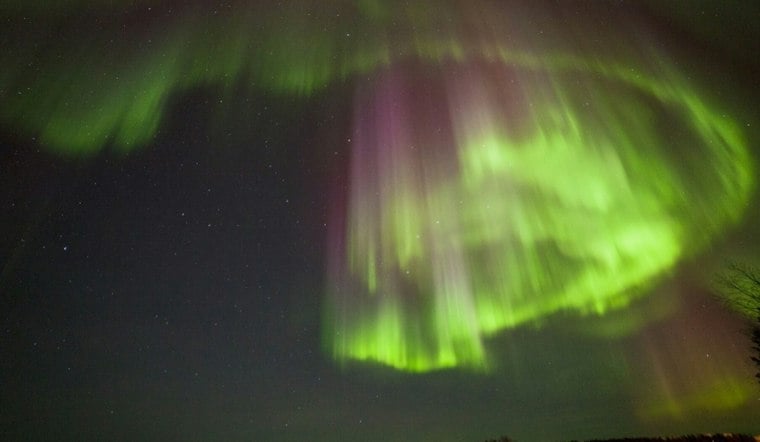
The key question for Connecticut skywatchers is not only whether a geomagnetic storm develops, but whether an aurora will be visible this far south. A coronal mass ejection, or burst of material from the sun, launched toward Earth early Tuesday, according to Space.com. Forecasters say a display Friday night is possible, but not assured.
NOAA's Space Weather Prediction Center has issued a watch for minor to moderate geomagnetic storm conditions for Friday, October 9, according to NOAA / NWS Space Weather Prediction Center. The event is associated with an M1.4-class solar flare from sunspot region AR4549, reported by Space.com; NOAA's GOES-19 satellite imaged the sun as the eruption unfolded Wednesday afternoon, per Connecticut Post. The outlet reports that whether a display reaches this far south remains uncertain.
Why This Storm Might Not Put On a Show
A storm watch does not mean an aurora will be visible in Connecticut. Any display here could be faint and low on the northern horizon, and cloud cover and the storm's eventual strength will also matter. The forecast may shift as the coronal mass ejection draws closer, Connecticut Post reports.
The CME is traveling at roughly 560 kilometers per second, and SWPC has issued a moderate G2 watch for Friday, according to Space.com. Current models put its arrival in the early hours of Thursday UTC, though timing remains uncertain; NOAA expects minor-to-moderate storm conditions, with a possible G2 peak sometime between 5 and 8 a.m. Eastern. How far south any aurora might spread depends on how the CME's magnetic field interacts with Earth's, the outlet reports.
What a Storm Watch Can—and Can't—Tell You
A G1 or G2 watch signals forecast geomagnetic storm conditions, but it does not establish that auroras will be visible from Connecticut. NOAA's aurora product provides a 30-to-90-minute forecast of aurora location and intensity, making it a short-term update rather than a guarantee of visibility in Connecticut, according to NOAA / NWS Space Weather Prediction Center.
What Could Help — or Hurt — Your View
An earlier CT Insider report described northern and northwestern Connecticut as having a slight viewing advantage and gave a cloud-clearing outlook. Published August 28, that date-specific cloud forecast should not be taken as a forecast for October 9; skywatchers should check conditions closer to Friday night.
The strength and reach of any display are difficult to pin down because they depend on the speed, density and magnetic orientation of the incoming solar material, according to Forbes. That uncertainty is why a regional storm forecast alone cannot settle whether Connecticut will see an aurora.
Tips for Skywatchers Friday Night
Connecticut Post advises skywatchers to check NOAA's aurora forecast and local cloud forecasts Friday night before heading out, and to find a dark spot with a clear view north away from city lights. Space.com notes that auroras have previously been seen as far south as New York and Idaho during storms of this strength, which is the main reason forecasters haven't ruled out a Connecticut sighting entirely.
An Aug. 28 forecast described northern and northwestern Connecticut as having a slight viewing advantage. Whatever happens Friday is expected to fall well short of the historic shows from 2024, when a May storm reached G5, or extreme, levels and an October storm that year hit G4, or severe, strength, according to CT Insider's earlier reporting.
Space.com also flags another window worth watching: a separate enhanced period of geomagnetic activity is predicted around Sunday, Oct. 11, driven by fast solar-wind streams from coronal holes, giving skywatchers a possible second chance if Friday night disappoints.



