

























































StarStuff: A Festival of Solo Artists returns to Capitol Hill’s Kerry Hall for three days starting October 23, bringing new programming to the revived arts venue. Ticket links accompany the festival’s event listings. The festival is produced by Astro Lab Productions, a Seattle company that began taking shape during the pandemic and has since co-produced a Tony-nominated Broadway play.
Created by local theater artist Billie Wildrick, StarStuff debuted in 2025 at Seattle’s Reverie Ballroom, according to The Seattle Times. Its program pairs interdisciplinary work, original songs and solo shows, including newly written songs responding to the solo performances. This year’s lineup includes violinist Tricia Buzzard, aerialist Tanya Gagné, performance artist Bhama Roget and singer-songwriter Lauren Drake. Teaching artists will also lead workshops throughout the weekend.
From a Pandemic Side Project to Broadway
Astro Lab grew from Erin and Greg Coomer’s effort to support composer and music director Christopher DeLair’s musical Signs of Life. After backing DeLair in 2023 so he could focus on writing, Erin Coomer launched Astro Lab in January 2024 and became its co-founder and CEO; Greg Coomer, a visual artist and longtime product designer at Valve, is also involved, the Yakima Herald reported.
Since then, the operation has scaled up fast. Paula Tharp joined as managing producer, and Astro Lab went on to co-produce John Proctor Is the Villain, Kimberly Belflower's modern feminist reexamination of Arthur Miller's The Crucible set in a Georgia high school. The play earned seven Tony Award nominations during its 2025 Broadway run at the Booth Theatre and was optioned for a Universal Pictures film adaptation directed by Danya Taymor, according to Playbill.
DeLair's own musical has had a notable run too. Astro Lab released a concept album for Signs of Life featuring Shoshana Bean, Jinkx Monsoon, Jenn Colella, Deborah Cox, and Vanessa Williams. In February 2026 the show got a benefit performance at Seattle's Neptune Theatre, and in April 2026 it landed a one-night concert at Jazz at Lincoln Center's Appel Room in New York, with Bean and Colella singing DeLair's 12-zodiac-inspired score, per the same Playbill report.
A Festival as Incubator
StarStuff isn't just a one-off showcase — it has already functioned as a launching pad for new work. Singularities and Safety Pins, a solo show written and performed by Carmella Riley, was originally developed at Piven Theatre Workshop and had a Chicago run before touring to Seattle as part of Astro Lab’s inaugural StarStuff festival. Astro Lab later produced its Los Angeles premiere at The Colony Theatre in Burbank in June 2026, staged in partnership with Sonder Theatre Company, as reported by TheatreSourceLA. Astro Lab says it is also developing the Seattle-grown work Aviatrix, which will get a local workshop and presentation in January 2027, along with a documentary film about the band Lucius, Lauren Gunderson's play Billie Jean, Sara Bareilles's musical The Interestings, and a project called Ms. Blakk for President, based on a drag queen's campaigns for Chicago mayor and U.S. president. The company says it has projects underway in New York, Los Angeles, and Chicago as well, with an explicit goal of making Seattle a destination hub for artists.
Ann Cornelius, who works as Astro Lab's marketing professional, has a personal connection to the company's flagship project — she performed in a workshop for Signs of Life. Erin Coomer has said the foundation of Astro Lab's mission is supporting artists, and the company emphasizes that it works to include local artists and collaborators in its decision-making. The Coomers fund Astro Lab themselves and say they have a multiyear plan for its sustainability. Tharp has said the company wants to preserve deep working relationships and tailor its support as it grows.
Kerry Hall's Second Act
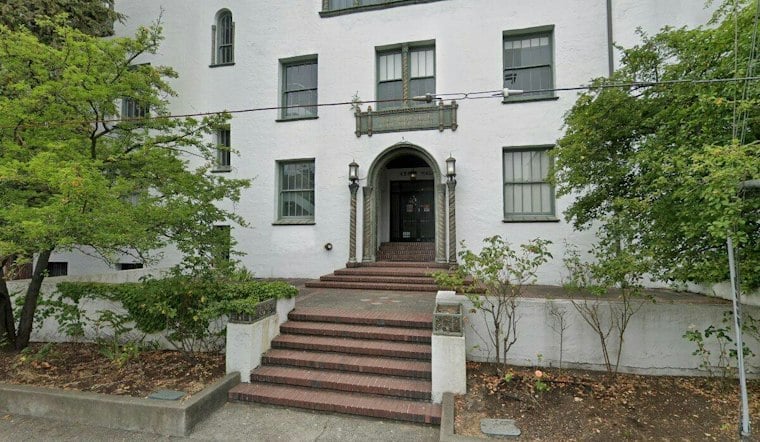
The festival's new venue has its own story of near-loss and rescue. Seattle Theatre Group purchased the 31,900-square-foot Kerry Hall from Cornish College of the Arts for $6 million in November 2024, as reported by CHS Capitol Hill Seattle News and according to the Puget Sound Business Journal, after the building was listed for sale earlier that year when Cornish consolidated its campus operations in South Lake Union. Built in 1921 as the original home of Cornish founder Nellie Cornish, the 104-year-old Spanish colonial revival building is listed on the National Register of Historic Places.
Hoodline previously covered STG's purchase of the landmark as it worked to protect the building from redevelopment. Seattle Theatre Group has estimated that operating Kerry Hall requires just over $1 million annually for its first three years, with the building's 190-seat theater and more than 30 studio rooms doubling as space for community programs like STG's free AileyCamp, according to KNKX Public Radio. The group also offers low-cost studio and rehearsal rentals there to support local performing artists. Kerry Hall now joins STG's broader venue portfolio, which includes the Paramount, Moore, and Neptune theaters in Seattle along with an outdoor space at Remlinger Farms in Carnation — a footprint the nonprofit has built since purchasing the Paramount in 1994.
What preservation means for Kerry Hall
Kerry Hall’s historic status does not protect every part of the building: Seattle Met reported that only its facade is protected by its historic landmark status. Seattle’s Office of Arts & Culture says its Cultural Space program works to preserve and create cultural space and support artists and arts organizations in shaping their creative spaces; the city describes that broader goal, not a specific program role at Kerry Hall, on its Cultural Space program page. A separate Seattle example is Washington Hall in the Central District. Historic Seattle acquired it in 2009 to save it from demolition, then undertook a community-development renovation involving grassroots anchor organizations, according to Washington Hall’s official history. That history offers a comparison in returning a venue to cultural use, while Kerry Hall’s current story centers on STG’s purchase and ongoing arts programming.
StarStuff is presented in partnership with Seattle Theatre Group, and its return to Kerry Hall ties two local preservation stories together: a nonprofit saving a century-old arts building, and a self-funded production company trying to keep solo performers working in the city that birthed their shows. Ticket links are available with the festival’s event listings.





