

























































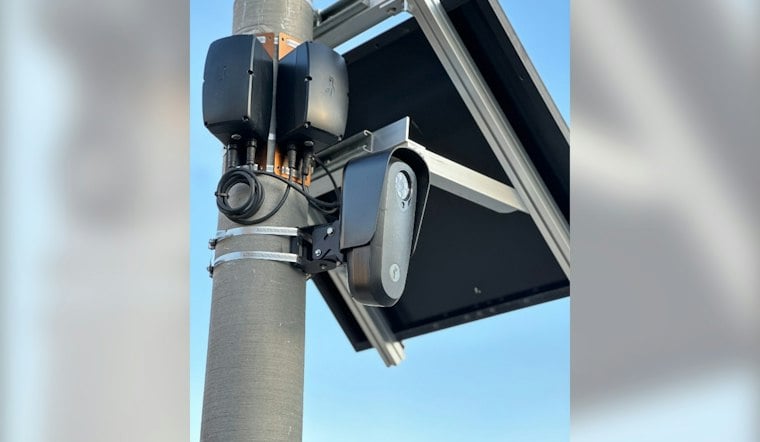
Suffolk County legislators spent more than two hours grilling Flock Safety representatives on October 8th over the company's network of roughly 200 license-plate-reading cameras scattered across the county, demanding answers on data retention, access controls and whether the technology can be used to track innocent drivers' every move. The hearing grew heated as lawmakers invoked constitutional law, cited a recent federal court ruling, and openly questioned whether Suffolk's five-year, $5 million contract with the company needs stronger legal guardrails.
Cameras, Data and a Contentious Legal Debate
Suffolk County has a $5 million contract with Flock Safety, according to abc7ny.com, which also reported that roughly 200 Flock cameras currently operate across the county and that the retention period for the data they collect is 30 days. That retention window is well beyond the seven-day default Flock now sets for new customers, a gap lawmakers zeroed in on throughout the hearing, as reported by the New York Post. Legislators pressed company representatives on a range of issues, including data security, camera locations, data retention policies and public transparency, according to CBS News New York.
Flock cameras scan and store information on every vehicle that passes them, logging license plates alongside identifying features like dents, bumper stickers and roof racks, per the Post's reporting. The system can also ping law enforcement about possible violations, and the resulting data is searchable by police nationwide, capable of helping map a vehicle's movements over time. Flock representative Trevor Chandler countered that the system is built to identify vehicles, not people, telling CBS News New York that it is “not facial recognition,” adding, “It's about vehicles, not people. No personal records, no DMV information.” A separate report from The Hill noted that Flock's automated readers log plate numbers and a so-called “vehicle signature,” but do not collect biometric data from a vehicle's occupants.
Jim Crow Comparison and a Pointed Fourth Amendment Clash
The hearing's sharpest exchange came when Legislator Anthony Piccirillo challenged Flock's claim that 99% of courts have found its cameras constitutional, a figure the company cited in its defense, per the Post. Piccirillo shot back that “99% of courts upheld Jim Crow laws for 56 years,” arguing that other courts would eventually catch up to a more skeptical view of the technology. Flock representative Trevor Chandler argued the company's technology does not violate the Fourth Amendment, but Piccirillo pressed further, asking whether Flock's nationwide network could be used to reconstruct an individual's movements over time — a capability Flock representatives ultimately conceded, according to the Post's account of the hearing.
The exchange echoed a federal ruling out of Oklahoma, where a judge found that a warrantless police search using Flock's system amounted to indiscriminate mass surveillance and violated the Fourth Amendment, per the Post's reporting. Flock, for its part, maintains that each law-enforcement agency controls how its own data is shared and that all searches are logged and auditable, according to Newsday. The company's evidence policy states that customers retain ownership and control of data generated through their use of the platform, and that all license-plate-reader data is permanently deleted and irretrievable once a customer's retention period expires, per Flock Safety's published evidence policy.
A CEO's Comments and a Missed Meeting Add to the Tension
Piccirillo also criticized Flock CEO Garrett Langley for calling company critics terrorists, a remark that added friction to an already contentious session, the Post reported. Legislator Trish Bergin said lawmakers were “very concerned about Big Brother watching,” while Legislator Chad Lennon, an Afghanistan War veteran and Purple Heart recipient, joined colleagues in pressing the company on oversight. The scrutiny was sharpened by the fact that Flock representatives had skipped the previous month's meeting despite being called to testify, and Joe Rosenberg, who oversees Flock's Suffolk County account, was among those who ultimately answered questions this time.
Lawmakers Eye New Local Law as Gunfire-Detection Deal Looms
Legislator Greg Doroski said the legislature is working with the county police department on a strict local law to regulate police searches of Flock data, one that would make Flock Safety liable under its terms, according to the Post. Suffolk lawmakers broadly said they would consider legislation that puts guardrails into law around data auditing and access tracking, Newsday reported, and said they will continue reviewing policies and safeguards governing the technology, per abc7ny.com.
Doroski also noted that lawmakers need to reconvene after a separate committee already passed a $4 million deal with Flock Safety for Raven listening devices, a gunfire-detection system Suffolk County approved without a legislative hearing, according to the Post. Newsday has separately reported that Suffolk's gunshot-detection arrangement with Flock was expected to cost roughly $800,000 less per year than ShotSpotter, the technology now known as SoundThinking that the county had relied on for more than a decade in areas with high rates of gun violence.
Part of a Wider National Reckoning
Suffolk's hearing lands amid broader national pushback on Flock's technology. More than 50 agencies or communities have canceled, suspended or rejected a Flock contract or deactivated their cameras since the beginning of 2026, according to Stateline, which also reported that more than a dozen states have enacted laws governing technologies like automated license-plate readers, though no consistent national framework exists. In response to mounting scrutiny, Flock Safety announced it would implement new safeguards addressing potential police misuse of vehicle-movement data, according to NBC News. Those planned changes include requiring law-enforcement users to attach case codes to searches and automatically suspending accounts flagged for abnormal activity, per Stateline's reporting.
For now, Suffolk lawmakers appear focused on tightening local rules rather than scrapping the cameras altogether. The push for a local law that would hold Flock Safety liable, paired with ongoing review of data-access policies, suggests the county's roughly 200-camera network will remain in place while legislators work to define exactly who can search it, and why.





