

























































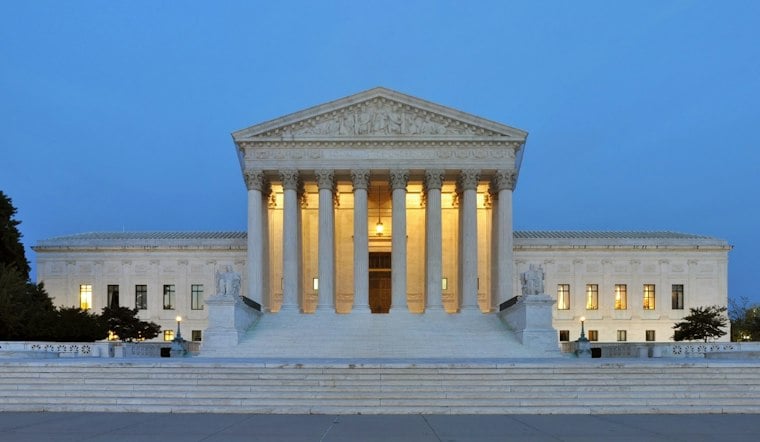
A last-minute legal scramble over how much political parties pay for TV airtime landed back at the Supreme Court this week, after the Trump administration asked the justices to block an appeals court order forcing the Federal Communications Commission to make a decision by noon Friday. Chief Justice John Roberts paused that deadline Thursday while the full court weighs whether to step in, keeping the FCC's current policy in place for now.
The fight centers on a March 30 public notice from the FCC's Media Bureau suggesting that political parties and joint fundraising committees should get the same rock-bottom advertising rates that federal law already reserves for individual candidates during the weeks leading up to an election, according to SCOTUSblog. Under federal election law, those preferential rates kick in during the 45 days before a primary and the 60 days before a general election, per the same outlet. Four Democratic congressional candidates, including Sen. Jon Ossoff of Georgia, asked the full FCC on April 29 to review the Media Bureau's notice, arguing it never should have extended those discounted rates beyond individual candidates.
A Rule Democrats Say Tilts the Playing Field
Democrats have argued the broader rule favors Republicans, whose party committees have more money to spend on ads, while Democratic candidates lean more heavily on small-dollar donations, the news organization reported. Republican campaign committees, which hold a cash advantage, are backing the administration's position and hope the policy helps them hold onto control of Congress heading into the midterms, according to The Hill. A September report from POLITICO similarly found that the decision delivers what it called a lopsided benefit to the GOP given party committees' financial edge before the midterms.
Those financial stakes come against a backdrop of significant party spending power. Political party committees reported combined federal receipts of $834.1 million and disbursements of $664 million, with $310.7 million in cash on hand, according to the Federal Election Commission.
Fourth Circuit Sets a Deadline, DOJ Objects
The legal back-and-forth escalated when the U.S. Court of Appeals for the Fourth Circuit directed the FCC to issue its decision on the candidates' petition for review by noon Friday, according to SCOTUSblog. That order followed the Supreme Court's own Sept. 4 ruling, an 8-1 decision according to the Denver Gazette, in which the justices found the Fourth Circuit had prematurely halted the FCC's rule and that the FCC must decide the candidates' petition before the appeals court can intervene. That September stay restored the FCC's broader lowest-unit-charge interpretation while the underlying case proceeds, Inside Radio reported, though the Supreme Court did not rule on whether that interpretation is actually lawful.
Solicitor General D. John Sauer asked the justices to block the Fourth Circuit's new deadline, calling the appeals court's order a flagrant abuse of mandamus and an effort to circumvent the Supreme Court's prior stay, per the Denver Gazette. Sauer argued a writ of mandamus was inappropriate because the challengers had delayed for months, and he warned that late judicial intervention could disrupt campaign-finance rules just weeks before the election. He also contended it was reasonable for the FCC to refrain from deciding the underlying campaign-finance question so close to Election Day, and the administration claimed the Fourth Circuit's order would let the appeals court strike down the rule less than a month before voters go to the polls.
What Happens Next at the FCC and the Court
The FCC's order does not dictate what the commission must decide, only that it must decide something: the agency could uphold, reverse, or otherwise dispose of the candidates' application for review, according to Inside Radio. Before issuing any decision, the FCC must also complete procedural steps, including opening the rule change to public comment, per the Denver Gazette's reporting.
Roberts ordered the challengers to respond to the Supreme Court by 5 p.m. EDT on Saturday, SCOTUSblog reported, and the court has not set a timeline for ruling on the broader emergency application. The case lands on an emergency docket that already includes another major election-related dispute, over the administration's new mail ballot order, which the Supreme Court has allowed to remain blocked through the midterm elections, according to the Denver Gazette.
Underlying the dispute is a legal argument over what Congress meant by the word “candidate” in the Communications Act. The Fourth Circuit's opinion argues the term means candidate, and that the FCC's public notice unlawfully required broadcasters to extend the lowest unit charge to political parties and joint fundraising committees that include non-candidate members, according to the U.S. Court of Appeals for the Fourth Circuit. FCC materials note that Section 315 of the Communications Act was designed to guarantee equal access to broadcast facilities for legally qualified candidates for office, according to the Federal Communications Commission.



