

























































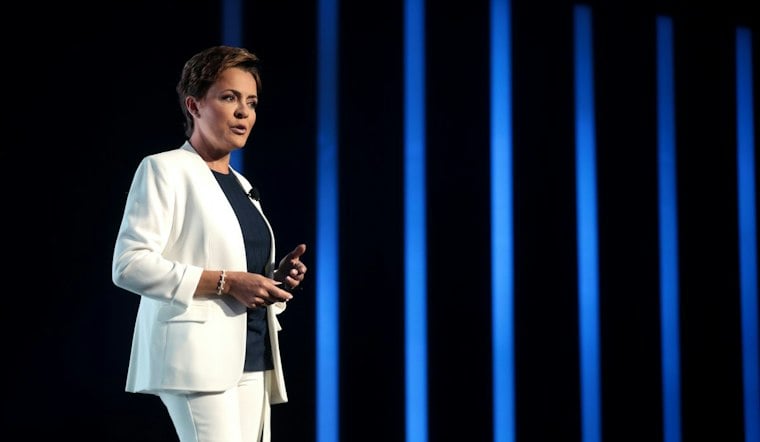
The U.S. Supreme Court has refused to toss out a $122,000 legal-fee sanction against attorneys who represented Kari Lake and Mark Finchem in their failed 2022 lawsuit seeking a hand-count of Arizona's midterm ballots. The denial, issued Tuesday, ends years of appeals by the lawyers themselves, not Lake or Finchem, who are not personally on the hook for the money.
A Years-Long Fight Over a Dismissed Lawsuit
According to News4JAX, the Supreme Court denied a request from attorney Andrew D. Parker, who represented Lake, to review the lower-court decision ordering him to pay Maricopa County's legal costs. Parker had argued that the sanctions would discourage attorneys from bringing aggressive or novel legal claims, the outlet reported. The underlying case, filed by Lake and Finchem, sought a ban on electronic tabulation devices and a full hand-count of ballots in the 2022 midterms, but a judge dismissed it after finding the pair lacked standing and had filed too close to the election.
Lake lost the Arizona governor's race that year to Katie Hobbs, while Finchem lost the secretary of state's race to Adrian Fontes, per the same report. Both candidates had promoted the narrative that the 2020 election was marred by fraud. Maricopa County later sought sanctions against Lake, Finchem and their lawyers, alleging the attorneys made unfounded allegations and failed to conduct the research required before filing.
Judge Cited Specific False Claims
U.S. District Judge John Tuchi concluded that the lawsuit's claims lacked an adequate factual basis, that the lawyers had not made the standard pre-filing inquiry, and that they acted recklessly in seeking an order based on frivolous claims, according to the News4JAX report. Per county attorneys, the lawyers falsely alleged that Arizona did not use paper ballots and that the state's electronic voting systems had not undergone expert analysis. As detailed by KJZZ, Judge Tuchi's ruling specifically flagged those claims as false given that Lake and Finchem themselves had cast paper ballots in the election.
Maricopa County also said the lawyers disregarded a letter identifying the false allegations and then reused some of them in a later filing. The legal-fee payment requirement applies to the lawyers who pressed the lawsuit — Parker, his firm Parker Daniels Kibort LLC, Kurt Olsen and his firm Olsen Law PC — rather than to Lake and Finchem, a distinction KJZZ's reporting and the county's own sanctions motion both emphasize. The Arizona Capitol Times reported that the order required the attorneys and their firms to pay Maricopa County's defense expenses directly.
A Split Appeals Court and a Dershowitz Escape
The 9th U.S. Circuit Court of Appeals rejected appeals over both the lawsuit's dismissal and the legal-fee award, the Associated Press reported in the original News4JAX piece, with the Associated Press noting it had left phone and email messages for Parker without immediate response. But the appellate bench was not unanimous. Appellate Judge Patrick Bumatay dissented from the March 2025 ruling affirming the sanctions, arguing the filing “may not have been drafted with perfect precision” but reflected zealous advocacy rather than intentional deception, according to the Arizona Capitol Times. Bumatay contended that playing hardball in litigation does not automatically warrant fee shifting.
That same month, the 9th Circuit separately threw out a $12,200 sanction against constitutional scholar Alan Dershowitz, who had served as a limited adviser on trade-secret claims involving voting-machine software. As Courthouse News reported, the panel found existing case law did not clearly establish Rule 11 liability for of-counsel attorneys with such a narrow role. Months later, six 9th Circuit judges dissented from the full court's refusal to rehear the case en banc, with the dissenters contending, per the ABA Journal, that advancing a Hail Mary legal theory in an election challenge did not justify punishing the attorneys who brought it.
Rule 11 and a Pattern of Sanctions
The sanctions were issued under Rule 11 of the Federal Rules of Civil Procedure, which authorizes courts to penalize attorneys who submit filings lacking a reasonable pre-filing factual inquiry or presenting legally frivolous arguments. This was not the first court to penalize Lake's legal team over the 2022 election fight. In May 2023, the Arizona Supreme Court separately sanctioned Lake's lawyers $2,000 for making what it called an unequivocally false claim in state court that 35,563 uncounted ballots had been improperly added to Maricopa County's vote totals, according to Axios.
Arizona law already requires a layer of tabulator verification that the lawsuit's claims brushed past: under A.R.S. § 16-602, the state mandates post-election hand-count audits of selected precincts and early ballot batches to check electronic tabulator accuracy, rather than a full statewide hand count. Co-counsel Kurt Olsen had previously pushed election fraud theories following the 2020 presidential race and later resigned from the U.S. Department of Justice amid investigations into efforts targeting former government officials, KJZZ reported.
Tuesday's denial closes out the federal litigation but arrives as Lake continues to navigate political fallout from the broader saga. She testified before the Senate Foreign Relations Committee in June on her nomination to be ambassador to Jamaica, a process Hoodline has previously reported has stalled amid objections from within her own party.





