

























































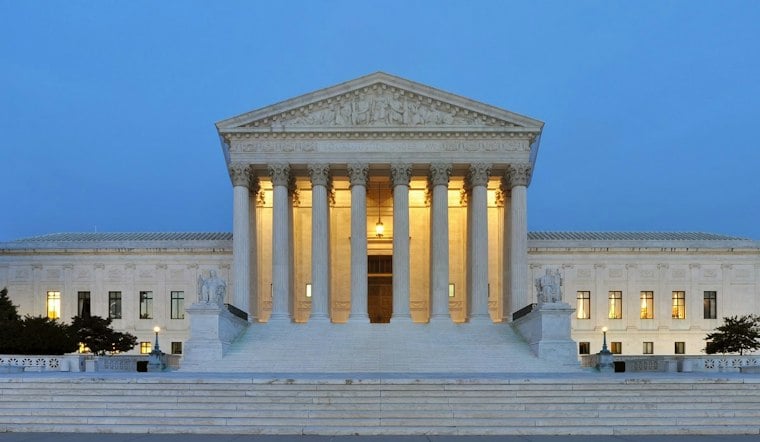
The U.S. Supreme Court declined Monday to hear Nexstar Media Group's bid to block DirecTV's antitrust lawsuit over allegedly inflated content-distribution fees, clearing the way for the case to move forward in federal court. The justices turned away Nexstar's appeal of a lower-court ruling that had reinstated DirecTV's suit, leaving the satellite provider free to pursue claims that could reshape how broadcasters negotiate carriage fees nationwide.
According to investing.com, the high court's order means Nexstar must now face DirecTV's claims in federal court in New York City, where the case was originally filed. DirecTV sued Nexstar and two station owners, Mission Broadcasting and White Knight Broadcasting, in 2023, alleging the companies violated antitrust law by denying DirecTV a competitive process for rebroadcast rights in specific markets, as detailed by Reuters. DirecTV accused the three companies of secretly working together to demand artificially high fees rather than letting market competition set the price.
How the Case Reached the Supreme Court
Nexstar's defense hinged on a narrower legal argument: that DirecTV had no standing to sue because it never actually paid the disputed rates. The company argued that a business can only sue over alleged price-fixing if it pays the allegedly inflated prices, the investing.com report notes, and DirecTV refused to pay what it considered artificially high fees during the dispute.
A federal judge initially sided with that reasoning and dismissed DirecTV's lawsuit. But the 2nd U.S. Circuit Court of Appeals reversed that decision in December, ruling that DirecTV could still pursue its antitrust claims based on alleged lost profits from being unable to distribute Nexstar's channels, according to the same Reuters report. That reversal is what sent Nexstar to the Supreme Court this year in a last-ditch effort to shut the case down before it could proceed.
Dueling Numbers on the 2023 Blackout's Toll
The legal fight traces back to a carriage dispute that played out in public view in the summer of 2023, when stations went dark for DirecTV subscribers nationwide. Accounts of the blackout's scope vary: DirecTV has said in court filings that it lost nearly one million subscribers after declining to pay the demanded fees, per Reuters, while investing.com reported DirecTV's account that thousands of customers canceled subscriptions and the company lost revenue as a result. Separately, Deadline reported at the time that more than 150 local stations went dark and roughly 10 million customers were affected across DirecTV, U-verse and DirecTV Stream.
The standoff eventually ended that September, when DirecTV and Nexstar struck a new multi-year distribution deal after a blackout that had stretched 76 days, according to the Los Angeles Times. That same report described the blackout as affecting 159 Nexstar-owned local stations, a figure that differs from Deadline's count — a discrepancy that underscores just how messy the public record on the dispute's scale has become.
Nexstar Warns of Broader Fallout, DirecTV Pushes Back
In its Supreme Court filing, Nexstar argued the 2nd Circuit's ruling conflicts with decisions from other federal appeals courts, a claim DirecTV disputed outright. The Desk reported that Nexstar specifically pointed to precedents in the Ninth and Tenth Circuits, where courts have held that companies cannot sue based on hypothetical lost revenue, framing the 2nd Circuit's decision as an outlier that exposes sellers to sweeping liability and risks coercive settlement pressure untethered from any concrete market injury.
Not every judge on the 2nd Circuit panel agreed with the majority, either. Judge Richard Sullivan dissented from the December ruling, arguing that DirecTV's injuries were indirect and speculative, according to Reuters. Nexstar, headquartered in Irving, Texas, says it and its subsidiaries and partners own or operate 265 stations in 132 markets across 44 states, per its website — a footprint that makes the outcome of this fight consequential well beyond the original dispute. DirecTV is headquartered in El Segundo, California.
The broader industry backdrop helps explain why the stakes feel so high for both sides. Channel blackouts have become increasingly common in recent years as distributors like DirecTV, Charter Spectrum, Cox Cable and Comcast's Xfinity try to hold the line on costs rather than pass steep increases on to customers, the Los Angeles Times reported, even as broadcast TV ratings have declined nearly 50% over the past decade. With the Supreme Court declining to intervene, DirecTV's case against Nexstar now heads back toward further proceedings in New York, with no timeline yet for how or when the underlying antitrust claims will be resolved.





