

























































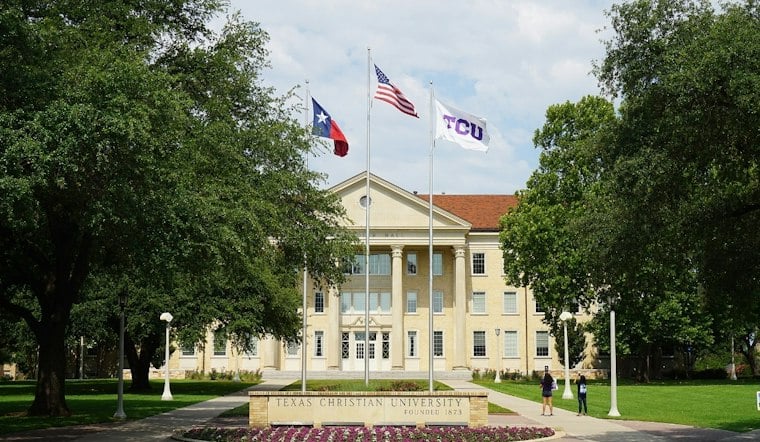
Texas Christian University Chancellor Daniel W. Pullin resigned Thursday, just 17 months into the job, and the university immediately turned to a familiar face to replace him: former chancellor Victor Boschini Jr., who is back at the helm with no interim tag attached to his title.
Pullin's resignation took effect immediately, and the university statement offered no explanation for his sudden exit and did not specify separation terms, according to the Fort Worth Report. Kit Moncrief, chair of TCU's Board of Trustees, said in a statement that the university thanked Pullin for his years of service and wished him and his family well, per the same outlet's reporting. Boschini was appointed chancellor on the spot, and Moncrief said he will execute TCU's strategic plan while overseeing daily campus life, the Fort Worth Report reported.
The turnaround is striking given how recently TCU celebrated the opposite transition. Boschini had announced plans to step down as chancellor effective June 1, 2025, moving into a chancellor emeritus role, with TCU naming Pullin as his successor at that time. Pullin officially began his tenure as the university's 11th chancellor that same day, according to tcu.edu.
A Short Tenure at the Top
Pullin's path to the chancellorship ran through TCU's own administration. He joined the university in 2019 as dean of the Neeley School of Business, then began a presidential tenure on Feb. 1, 2023, overseeing operations while reporting to then-chancellor Boschini. TCU's trustees and Boschini announced the succession plan in December 2024, and Pullin helped develop the university's expansion strategy before taking over as chancellor.
A Plano native, Pullin earned undergraduate degrees in accounting and finance from the University of Oklahoma, an MBA from Harvard and a law degree from Oklahoma, according to the dossier of biographical facts tied to his appointment. He also served as dean of Oklahoma's Price College of Business and worked at McKinsey & Company and in private equity before coming to Fort Worth. In his resignation, Pullin said he is proud of TCU students and will remain invested in what the university stands for.
Pullin's departure also fits into a broader pattern of upheaval among Tarrant County's higher-education leadership. He is the third Tarrant County higher education leader to depart in the past two months, following Jennifer Cowley's step-down as University of Texas at Arlington president in August 2026 to return to a faculty role, and the Oct. 20 selection of Bobby Ahdieh as the next president of Pace University in New York.
Boschini's Long Run and What Comes Next
Boschini is no stranger to the office he now reoccupies. He led TCU for 22 years before stepping down in 2025, a tenure during which he and his leadership team doubled the university's student enrollment and grew TCU's endowment to $2.6 billion, according to star-telegram.com. Before arriving at TCU, Boschini spent about four years as president of Illinois State University. Nationally, presidents of higher-education institutions serve less than six years in the role on average, per an American Council on Education study cited by the same outlet.
TCU, a private institution, enrolled 13,241 students and welcomed its largest incoming class for the second consecutive year in 2026. The university has laid out a decade of planned expansion that includes enrolling thousands more students, building new housing and increasing its research profile, with a goal of reaching roughly 17,900 students by 2035.
Central to that push is an ambition to attain Carnegie R1 research-university status by 2035, a designation based on research spending and doctoral production. Star-telegram.com has reported that TCU has been increasing its research investment but still has a ways to go, with research operating expenses topping $17 million in the 2023-24 academic year, up from more than $14 million the year before. As of that reporting, only 187 U.S. universities, including 16 in Texas, held R1 status, among them UT Southwestern Medical Center, the University of North Texas and UT Dallas — with nearby SMU also having spent more than a decade pursuing the designation, awarding 139 research doctorates in 2023.
Housing, Athletics and a Financial Aid Push
TCU has also moved to back up its growth plans with new infrastructure. The university announced more than $500 million in outside investment for two developments in 2025, intended to accommodate enrollment growth by fall 2027. One campus housing development includes 2,450 beds, while a second project, Morado on Berry, includes about 780 beds and retail space.
On the athletics side, TCU launched the Roach Institute of Athlete Engineering in June 2026 after receiving a $10 million gift, an effort aimed at connecting research on athletic performance with applications for military personnel, first responders and workers in physically demanding jobs. The university also launched the TCU for Texans financial aid program, which serves qualifying incoming Texas students from families earning below $100,000 a year, providing full tuition and some assistance with food and housing to students who meet Pell Grant eligibility and other requirements.
Not every recent decision at TCU has gone unquestioned. The university announced plans in October 2025 to fold its race and gender studies departments into the English department, a move TCU administrators attributed to enrollment and financial concerns while denying any political motivation. TCU faculty members have questioned the lack of consultation behind that decision and whether political pressure played a role, according to reporting tied to the university's internal deliberations.
As of Thursday, TCU had not filled the university president position left vacant by Pullin's departure from that earlier role, leaving open questions about how the university's leadership structure will take shape under Boschini's renewed tenure.


