

























































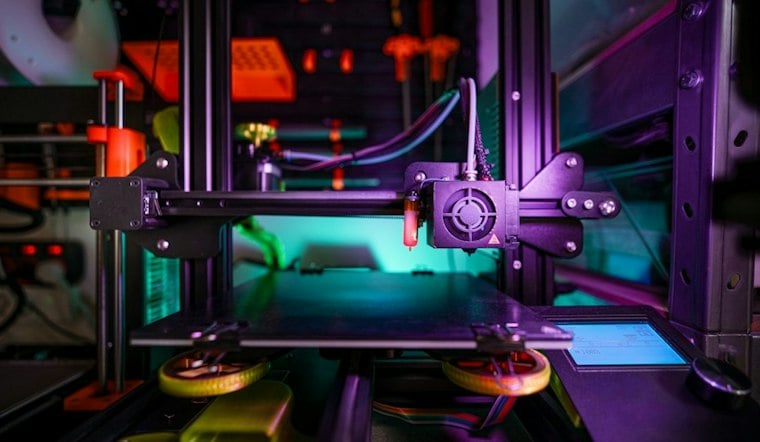
Texas A&M University is building a laboratory in College Station where robots, not graduate students, will do the dirty work of melting and testing new metal alloys. The university announced on October 26 that it is creating the Aggie AI Foundry, a fully automated metallurgy lab funded by a $2 million grant from the WoodNext Foundation, with the goal of shrinking alloy development timelines from months to days.
Robotic Arms Replace Grad Students at the Bench
According to Houston Public Media, the foundry will rely on computer-controlled robotic arms arranged along an assembly line to mix, melt and test candidate alloys, a process Texas A&M describes as using “AI brainpower and robotic workers,” per Texas A&M. The university says the system will be capable of developing and testing alloys at temperatures up to 3,000 degrees Celsius, and it is billing the lab as the first of its kind in academia. Houston Public Media's report frames that distinction more specifically, describing it as the first laboratory of its kind in Western academia.
The foundry was created by materials science professors Ibrahim Karaman and Raymundo Arróyave, who have co-authored more than 100 papers together on alloy design algorithms, the university's report notes. Arróyave, who studied as a graduate student at MIT, told Houston Public Media that artificial intelligence could sort through roughly a trillion possible combinations of elements from the periodic table — a scale of search that would be impossible to tackle by hand.
A $2 Million Gift From a Roku-Connected Foundation
The WoodNext Foundation, the philanthropic organization funding the project, was founded by Roku CEO Anthony Wood and his wife, Susan — both Texas A&M alumni, according to Houston Public Media's reporting. Arróyave said his aim is to democratize access to metallurgy, accelerate how fast new materials can be developed, and free students and postdoctoral researchers to apply their creativity rather than spend years on repetitive lab work.
That ambition echoes a broader push already underway at Texas A&M. A separate, six-year, $24.9 million grant from the National Science Foundation is funding the Autonomous Robotic Metallurgist Materials Innovation Platform, or ARM-MIP, which will be sited at the Texas A&M University System's RELLIS Campus in Bryan, according to Texas A&M Engineering. That platform is designed to serve more than 200 outside researchers a year and produce 50 alloys a month in its first year, scaling to more than 200 alloys monthly by its sixth year, with robotic systems melting, shaping, heat-treating and testing alloys around the clock while AI software analyzes results and chooses the next experiments.
Concerns That Automation Could Dilute the Profession
Not everyone is cheering unreservedly. Arróyave said students, researchers and others have raised concerns that leaning so heavily on AI and robots could dilute the metallurgy profession, Houston Public Media reported. He pushed back on the idea that the foundry removes people from the equation, calling humans fundamental to the process and noting that even a promising new material discovered by the machines will still require careful, detail-oriented investigation by researchers afterward.
Arróyave drew on his own graduate-school memories to make the point, recalling bloody fingertips from hours spent manually polishing samples — the kind of grinding task he said automating polishing could eliminate, making research easier rather than less rigorous. He said students and humans will continue to play a role inside the automated lab, with the Aggie AI Foundry freeing them to focus on higher-level research instead of repetitive bench work. In his view, the lab will train a new kind of scientist, one who has to learn more than previous generations of metallurgy students did.
Part of a Wider National Trend
Texas A&M's engineering unit points to its existing BIRDSHOT program as evidence the approach works: that program has shown a 100-fold acceleration in alloy discovery and has designed, synthesized and characterized more than 1,150 alloys in four years, per Texas A&M Engineering's account. The university argues the new facilities will let students and researchers spend less time making samples and more time making discoveries.
Texas A&M isn't alone in chasing automated materials science. ARM-MIP will be the fifth Materials Innovation Platform funded by the National Science Foundation and the first built specifically for metals, according to Texas A&M Engineering. At Carnegie Mellon University, the Materials Innovation Cloud Lab at Mill 19 in Pittsburgh's Hazelwood Green is moving toward a similar self-driving model, with an initial focus on automating aluminum alloy powder production for aerospace use, according to Carnegie Mellon University. National laboratories are experimenting along the same lines: Argonne National Laboratory has built an AI-driven lab called Polybot to explore processing pathways for electronic polymer films, per Argonne National Laboratory, while Lawrence Livermore National Laboratory and Cornell University are developing a platform called APEX that combines robotics and machine learning to automate alloy production and characterization, according to Lawrence Livermore National Laboratory.





