

























































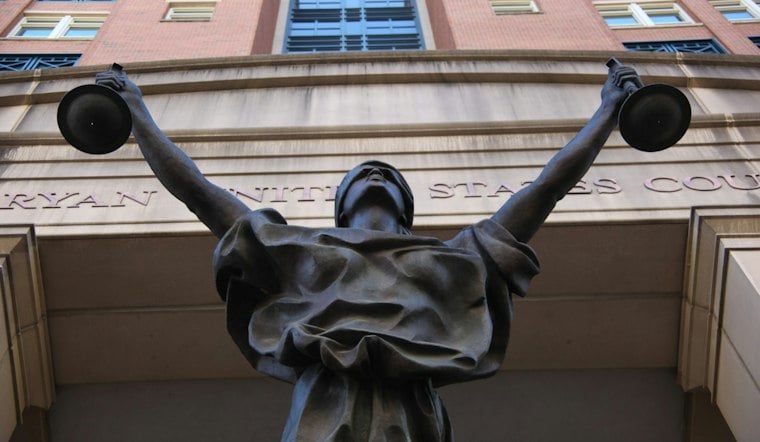
A former Ugandan military officer with deep ties to the country's political elite appeared in federal court in Alexandria, Virginia, this week after being extradited from Kampala to face charges tied to an alleged cocaine-trafficking and weapons conspiracy linked to Mexico's Jalisco New Generation Cartel. Michael Katungi Mpeirwe, 45, was arrested in Kampala in June and now faces a case U.S. prosecutors say stretches from Bulgaria to Tanzania to the cartel's arsenal in Mexico.
Katungi's initial appearance at the U.S. District Court for the Eastern District of Virginia was confirmed by the U.S. Department of Justice, which filed the case under docket number 1:25-CR-102 after a grand jury indictment that had been sealed since April 2025. As reported by ChimpReports, Katungi faces conspiracy charges involving cocaine distribution, firearms possession in furtherance of drug trafficking, and providing material support to a designated foreign terrorist organization. If convicted, he faces a mandatory minimum of 10 years and up to life in prison, according to the Justice Department. He has not been convicted, and the indictment remains an accusation prosecutors must still prove in court.
A Political Fall From Grace in Kampala
Before his arrest, Katungi held a string of prominent posts in Uganda, including serving as a retired Uganda People's Defence Forces lieutenant. The indictment describes him as a Ugandan-government policy adviser and a security logistics officer associated with the African Union Commission. The Independent Uganda describes him as a former External Affairs Commissioner of the Patriotic League of Uganda, a party chaired by Gen. Muhoozi Kainerugaba. Kainerugaba, the son of Ugandan President Yoweri Museveni, removed Katungi from his political post once the U.S. indictment was unsealed, the outlet reports.
Katungi fought his extradition on multiple fronts, per ChimpReports, challenging the process on grounds including diplomatic immunity, prosecutorial authority, and how Uganda handled the U.S. request. Chief Magistrate Ritah Kidasa Neumbe rejected those arguments on August 28, finding that the legal requirements for extradition had been met, according to UG Bulletin. Katungi also claimed diplomatic immunity based on prior service in Nigeria, but the court rejected the claim.
Uganda's Minister of Justice and Constitutional Affairs Norbert Mao issued the surrender warrant on September 1, directing the Commissioner General of Prisons to release and deliver Katungi to a U.S.-authorized official, per ChimpReports. Mao said the U.S. representative receiving Katungi under the warrant could hold him in custody and convey him from Uganda into U.S. jurisdiction, and he directed Ugandan authorities to facilitate the lawful transfer. The Independent Uganda notes that Mao approved the surrender under the framework of the 1988 United Nations Convention Against Illicit Traffic in Narcotic Drugs and Psychotropic Substances. The Justice Department separately acknowledged assistance from Uganda's Ministry of Justice and Constitutional Affairs and the Office of the Director of Public Prosecutions in securing the extradition.
Allegations of a $58 Million Arms Pipeline to CJNG
Federal prosecutors allege Katungi conspired beginning around September 2022 with Bulgarian national Peter Dimitrov Mirchev, Kenyan national Elisha Odhiambo Asumo, and Tanzanian national Subiro Osmund Mwapinga to supply military-grade weapons to the Cartel de Jalisco Nueva Generación, known as CJNG, according to ChimpReports. The alleged arsenal included machine guns, rocket launchers, grenades, night-vision equipment, sniper rifles, anti-personnel mines, and anti-aircraft systems. U.S. authorities allege the defendants believed CJNG intended to use the weapons to support cocaine shipments into the United States. Washington designated CJNG a foreign terrorist organization and specially designated global terrorist entity in February 2025.
Mirchev, described by the Justice Department as an international arms trafficker with 25 years of experience previously implicated in supplying weapons to convicted Russian arms dealer Viktor Bout, allegedly met people claiming to represent CJNG and agreed to organize arms transactions while evading law enforcement, prosecutors allege per ChimpReports. He is said to have recruited Asumo to obtain an end-user certificate falsely naming the weapons' intended recipient. Court records cited by the U.S. Department of Justice indicate the conspirators paid an initial bribe of roughly $30,000, wired to a Kenyan bank account in December 2022, to acquire fraudulent End-User Certificates and Delivery Verification Protocols from Tanzania meant to disguise arms shipments from Bulgaria. Those documents falsely listed the Tanzanian military as the weapons recipient.
Asumo, Katungi, and Mwapinga obtained a Tanzanian certificate authorizing importation of AK-47 rifles, U.S. prosecutors say, and the group allegedly arranged export of a test shipment of 50 automatic AK-47 rifles, magazines, and ammunition from Bulgaria intended for CJNG. Prosecutors allege the accused then pursued a far larger shipment that could have included surface-to-air missiles, anti-aircraft drones, and ZU-23 anti-aircraft weapons. Mirchev allegedly created a CJNG weapons list valued at approximately €53.7 million, equivalent to about $58 million, according to the Justice Department. Katungi, Asumo, and Mwapinga allegedly agreed to provide additional arms-control documents intended to conceal the cartel as the weapons' true recipient.
Co-Defendants Already Cooperating as Case Moves Forward
Two of Katungi's alleged co-conspirators have already pleaded guilty. Asumo, who was arrested by Moroccan security services in Casablanca in April 2025 and extradited to the U.S. in March 2026, pleaded guilty to conspiracy to distribute and possess cocaine with intent to distribute and is scheduled to be sentenced on November 4, per the Justice Department. Mwapinga, apprehended by law enforcement in Accra, Ghana, in April 2025 and extradited to the U.S. in July 2025, also pleaded guilty to the same cocaine conspiracy charge, according to Citizen Digital, and is scheduled for sentencing on January 13, 2027.
Mirchev, for his part, was arrested in Madrid in April 2025 and extradited to the United States in March 2026. The case was investigated by the DEA's Special Operations Division with assistance from the U.S. Department of War and authorities in Uganda, Spain, Morocco, and Ghana, ChimpReports reports. The Homeland Security Task Force is a whole-of-government partnership.
The case against Katungi lands amid a string of related federal prosecutions targeting CJNG's international supply lines. Hoodline previously reported on the guilty plea of a brother of top CJNG leadership and on an El Paso woman who pleaded guilty to arming the cartel. Those cases underscore how deeply U.S. authorities have pursued CJNG since its terrorist designation last year.





