

























































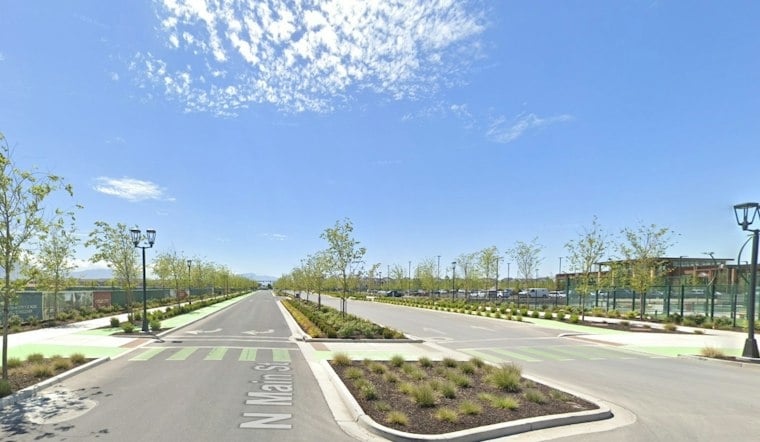
On a Vineyard August afternoon, Sarah Miller biked with her five-year-old son to a park inside Utah City, the roughly 700-acre development rising on the shore of Utah Lake that planners hope will become the city's walkable downtown. It's an ambitious bet in the middle of Utah County's car-dependent suburban sprawl, and it's one still very much under construction, both physically and politically.
Utah City is being built on the site of the former Geneva Steel mill, a nearly 2,000-acre plant constructed during World War II that went defunct in the 2000s, according to The Salt Lake Tribune. Vineyard approved tax incentives to clean up the former steel site, and the city's Redevelopment Agency paid for that cleanup, per the same report. The city has allowed thousands of housing units and high-rise buildings at the site.
From 139 Residents to a Boomtown
Vineyard's transformation has been fast by any measure. The town had just 139 residents in 2010, according to the Tribune, and ballooned to 6,175 by 2017 and 10,052 the following year — a 63% single-year jump that made it, at the time, the nation's fastest-growing city with a population of at least 1,000, per a 2019 Salt Lake Tribune report. A 2023 account from Utah Business put the city's population at more than 23,000, while the Tribune's newer reporting cites a current figure of about 16,000.
Utah Transit Authority built a FrontRunner stop at the site in 2022, and Utah City developers designed the project around that transit link. A path called the Greenline connects the FrontRunner station to Utah Lake, and the broader project includes a promenade with pickleball, tennis and basketball courts, per the Tribune. Urban designer Jeff Speck, who wrote “Walkable City: How Downtown Saves America, One Step at a Time” in 2012, was tapped to help shape the development — a detail Utah Business also noted when it reported that Speck and the firm DPZ were hired to design Utah City for walkability and sustainability.
Who's Building It, and Who's Paying
Flagborough LLC is developing Utah City, with The Flagship Companies spearheading the project; Nate Hutchinson is a partner in both firms, and Pete Evans is a co-managing partner of Utah City and Flagship. Woodbury Corporation, an original partner named in earlier coverage of the project, stepped away from Utah City in early 2026, the Tribune reported. Orem-based private equity firm Sandlot Partners, founded in 2020 and invested in real estate as well as oil and gas, now supports the development.
Public financing has played a role in the project. Separately, Vineyard paid Utah City developers $4.5 million in 2026, and city council members are now reviewing what those payments covered.
A Housing and Transit Reinvestment Zone is a state tool designed to encourage multifamily residential and commercial clusters around transit hubs. Under an HTRZ designation, local governments may use increased property-tax income to pay developers for up to 25 years, and reinvestment-zone funds may cover infrastructure and vertical construction costs above four stories.
A State Audit Raises Questions
A Utah State Auditor investigation found that Vineyard's Redevelopment Agency had not properly reported large developer payments, and a separate audit covering 2018 through 2024 found the RDA had not submitted all its transactions to the Transparent Utah website, according to the Salt Lake Tribune. The audit said the RDA omitted “substantial payments to developers” building projects like Utah City, and State Auditor Tina Cannon raised concerns about transparency.
Vineyard's government has pushed back on the characterization, responding to the audit findings. A later report from Deseret News said the city's replacement transparency records matched its general ledger — though that account does not resolve the scope of the original audit findings.
An independent audit examined the RDA's processes. Vineyard City Council member Jacob Wood said Utah City is a gamble and that city money should not be gambled, while council member David Lauret has questioned the public resources committed to the project, according to the Tribune.
New Leadership, Old Turnover
Ezra Nair served as Vineyard city manager from February 2022 to November 2023, then was selected to fill a Vineyard City Council vacancy after Sara Cameron resigned in November 2025; he is Utah County administrator. Zack Stratton became Vineyard's mayor in January 2026 and has spoken about public input and city finances, per the Tribune. Utah City now faces scrutiny from Vineyard's new mayor and city council members as the development continues.
What Living There Actually Costs
For residents like Cameron Larsen, 34, and Aunica Larsen, 29, who moved into a three-bedroom Utah City apartment in February 2026, the development's walkability is part of the appeal. Two apartment buildings known as 120 and 220 Bend were completed that same month. Developers have offered amenities including Sundance ski passes and unlimited Peloton fitness center access, and they plan to build a swimming pool.
But the price of that lifestyle runs well above comparable Utah County housing. Utah City studio apartments rent for $1,325 to $1,410 monthly based on a 17-month lease, excluding parking, pet rent and most utilities — compared with Provo studio apartments, which averaged $1,199 in late September 2026, according to rent.com data cited by the Tribune. Two-bedroom apartments in Provo averaged $1,543.
Those figures sit awkwardly against federal affordability guidelines, which cap recommended rent spending at 30% of household income. For a Utah County four-person household, that threshold works out to about $2,380 monthly; for a single-person household, about $1,670. The U.S. Department of Housing and Urban Development defines low-income households as those earning up to 80% of area median income, which in Utah County translates to an income threshold of $95,350 annually for a four-person household and $66,750 for a single person.
Utah City developers plan to construct thousands of housing units overall, including single-family homes available for purchase.
Betting on Transit in a Driving County
Utah City is designed around transit, and the development is planned in phases.
Health Care and Jobs on the Horizon
Utah City is set to become home to a Huntsman Cancer Institute hospital and research facility in 2028. The project began vertical construction in October 2026, nearly a year and a half after breaking ground, according to the Daily Herald. Plans call for a 284,000-square-foot cancer center as part of an estimated $400 million project, including a $75 million allocation from the Utah Legislature in 2024. Utah Business has reported that the Huntsman Cancer Institute expects the new location to bring 2,000 high-paying jobs to the area.
On the ground, the commercial buildout has been more modest so far. Bella's Market opened in late 2025, and Fini Pizza opened next door inside Utah City, giving early residents like the Larsens their first taste of the walkable downtown the developers have promised. Whether that promise scales to the 17 million square feet of mixed-use space envisioned for the full build-out — and whether the public financing questions swirling around Vineyard's Redevelopment Agency get resolved along the way — remains the open test the Tribune's reporting frames for the years ahead.





