

























































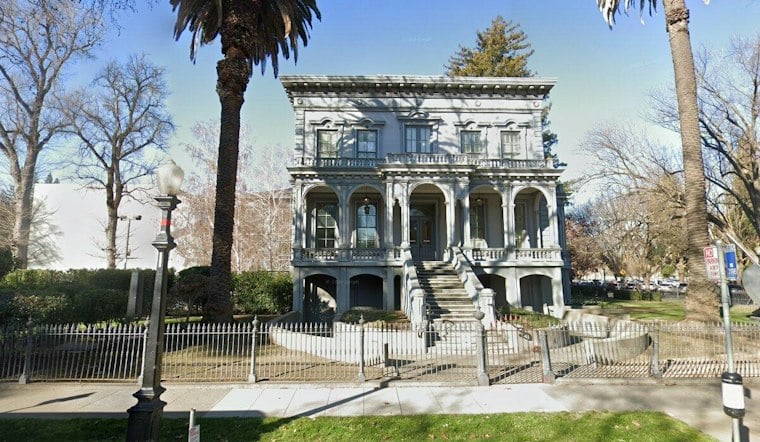
William T. Vollmann, the National Book Award-winning novelist who has lived for years in Land Park, gave his first-ever Sacramento reading last Saturday, sharing a sold-out stage at the Crocker Art Museum with 34-year-old local writer Devyn Defoe. The 67-year-old author, who had disclosed a diagnosis of terminal colon cancer, agreed to the joint appearance specifically to help boost Defoe's debut novel — a gesture that gave the afternoon an unmistakable weight for the roughly 250 people packed into the museum's capacity crowd.
The event, reported by Graham Womack of the Sacramento Bee, began at 2 p.m. on October 10 and ran for hours, with Vollmann and Defoe reading from their latest novels, fielding audience questions for about 30 minutes after each reading, and then signing books for more than an hour afterward. Readers traveled from around the United States to be there, including Jillian Dowis, who faced an 11-hour drive back home to Olympia, Washington, and Eli Winter, a 29-year-old artist who came from Chicago. Lily Rushing, the Crocker's public programs assistant, introduced the gathering.
A Novel Decades in the Making
Vollmann read from his latest work, *A Table for Fortune*, a sprawling, roughly 3,000-page, four-volume novel set scheduled to publish October 20. Arcade Publishing has described the project as centering on fictional CIA analyst Elliott Stevens and his family across a half-century of American foreign policy, from 1968 to 2019, tracing the arc from the Cold War through the War on Terror, according to Seminary Co-op Bookstores. Vollmann has published a dozen novels over his career, a body of work that began with his 1987 debut, *You Bright and Risen Angels*, which won the Whiting Award in 1988, per Arcade Publishing. He went on to win the National Book Award for Fiction for *Europe Central*.
Writing in an essay for Literary Hub published on September 28, Vollmann described *A Table for Fortune* as a dual project — a cerebral “novel of ideas” about CIA decision-making paired with a “novel of feelings” about family life, framing it as something he felt a duty as an American to write. A June studio visit account noted that Vollmann lives and works in Sacramento without a mobile phone or internet access.
Questions Turn Personal and Political
During the Q&A, Vollmann made a striking offer to an Iraqi-American woman in the audience who described being a victim of a hate crime: he proposed forming a study group with her. He told the crowd he had once visited Iraq around Saddam Hussein's birthday — Hussein served as president of Iraq from 1979 until his overthrow in 2003 — and suggested she try to forgive people who are simply ignorant, according to the Sacramento Bee's account of the event.
Vollmann also addressed climate change directly, telling the audience that even if carbon emissions stopped entirely today, the planet would keep warming for another 11,000 years, and that it would not fare well without some kind of high-tech miracle. Defoe also spoke about the state of the world in response to an audience question.
Defoe's Debut Draws From a Changed Central Valley
Defoe, who works at Beers Books and spent roughly six years writing her debut novel, read from *Burnside*, which Astra House published in August. In an August interview with Debutiful, Defoe said moving back to Sacramento inspired her to set a novel in the region, drawing on childhood influences like Lemony Snicket's *A Series of Unfortunate Events*. Before publishing *Burnside*, Defoe spent 2018 to 2020 as a Stanford University Wallace Stegner Fellow in fiction, placing short stories in journals including *Socrates on the Beach* and *The White Review*, per her listing with Peters Fraser and Dunlop Literary Agents.
At the Crocker, Defoe told the audience that the work of planning the event had left her little time to think about performing, and that she was simply eager to get through it. She is already at work on her second novel. For his part, Vollmann said he wanted the audience to connect with Defoe and hoped she was happy with how the day went, adding that he was glad he had agreed to take part and had enjoyed meeting everyone there.
The Crocker Art Museum had offered tickets to the October 10 reading and Q&A for $5 per person, restricting the event to attendees 18 and older in its program calendar. For a museum audience that filled all 250 seats, the afternoon doubled as a joint celebration of two very different books — one closing out a nearly four-decade career, the other just beginning.





