

























































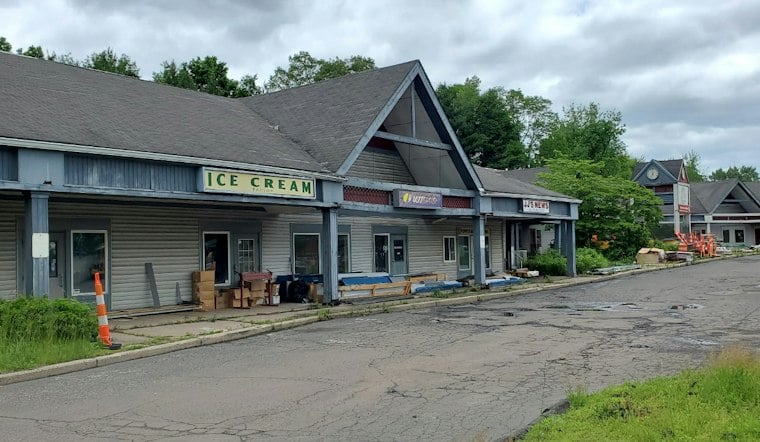
A derelict, 37,000-square-foot shopping center on Main Street in Windsor Locks is finally coming down for good, making way for a 120-unit mixed-income apartment complex just steps from the town's newly relocated train station. The ribbon-cutting for the $65 million station and the official groundbreaking for the housing project both took place Tuesday, marking a milestone years in the making for the small Connecticut town.
The 3.2-acre development site at 255 Main Street once housed the dilapidated strip mall, which required environmental remediation due to its prior commercial and industrial use, according to the Hartford Courant. Developer Trinity Financial plans an $85 million, two-phase project there totaling 120 mixed-income apartments and roughly 4,000 square feet of commercial space. The first phase alone costs $49 million and includes a four-story building with 70 apartments, 11 of which are designated affordable supportive housing units, plus about 2,000 square feet of commercial space, the Courant reports.
Dan Drazen, vice president of development for Trinity Financial, told the Courant the site's appeal comes directly from its proximity to the new transit hub. He said the development gives residents an opportunity to take part in the north end of Main Street's revival and access its amenities, and credited the town's Main Street Overlay Zone with helping attract Trinity Financial to the project in the first place. Drazen also described the town as supportive and enthusiastic throughout the process, per the same account.
A Station Returns to Downtown After Decades Away
The new train station represents a full-scale building closer to the center of town, a dramatic upgrade from the isolated park-and-ride platform south of Interstate 91 that Amtrak and CTrail riders have used for years. According to Patch, passenger train operations at the $65 million station are scheduled to begin on October 18, five days after Tuesday's ribbon-cutting ceremony, with Amtrak and CTrail services shifting roughly one mile north from their old spot. The Courant notes the new station restored rail service to downtown Windsor Locks after more than 40 years without it.
The relocation puts the stop approximately one mile north of its former location, back at its historic home on Main Street, according to Connecticut's Department of Economic and Community Development. Half of a $4.8 million Community Investment Fund award the town received from the state in 2023 went toward Trinity Financial's acquisition of the 255 Main Street parcel in spring 2024, the Courant reports. The town will use the remaining funds to improve and reopen the historic 1875 train station building to the public, converting the 2,300-square-foot structure into a welcome center with public restrooms, tourism information, and grab-and-go refreshments, per the state agency.
Future residents will also have transportation options beyond the rail line. The Courant reports the development will include a shuttle to Bradley International Airport, and state records filed with Connecticut's Council on Environmental Quality indicate CT Transit Bus Route 24 is slated to operate the scheduled bus service connecting the new transit hub to the airport.
Financing a Project Years in the Making
Demolition at the site started in July, and the project is now undergoing site work, according to the Courant. Phase one financing draws an estimated 40% from low-income housing tax credit equity, with additional funding from the Connecticut Department of Housing, the Connecticut Housing Finance Authority, the Department of Economic and Community Development, and private financing sources. The state is contributing $12.1 million toward the $49 million first phase, the Courant reports.
Drazen said the second phase is likely to begin in two to three years, a timeline shaped by construction costs that remain elevated statewide. Building material costs for new residential construction rose 42% between January 2020 and December 2025, the Courant reports, and Connecticut's state comptroller noted in a May economic update that affordable rental units can now cost nearly as much to build as luxury ones.
Jon Savino said the project marks a major first step in downtown revitalization and progress toward a vibrant, walkable, transit-connected community, according to the Courant. Municipal officials hope the first phase will spur a broader revival in the surrounding area.
A Long Road From Overlay Zone to Groundbreaking
The regulatory groundwork for this moment stretches back more than a decade. Windsor Locks municipal leaders established the Main Street Overlay Zone in 2012 to encourage walkable, high-density infill development and replace outdated strip commercial properties along the downtown corridor, according to the Commercial Record. The town has worked to bring redevelopment and investment along Main Street for nearly 20 years, the Courant notes, including restoration of the historic train station and corridor improvements.
The scale of the change becomes clearer against the town's recent housing history. Between 2000 and 2015, Windsor Locks added just 194 new housing units total, according to data in the town's 2020 Plan of Conservation and Development cited by the Commercial Record. Developer Beacon Communities' $62 million conversion of the former J.R. Montgomery Co. textile mill into 160 rental units at 25 Canal Bank Road, completed in 2019, offered an early precedent for the kind of downtown residential reuse now underway at 255 Main Street, per the same outlet.
The 255 Main Street project itself was designed by Hartford-based Amenta Emma Architects and received formal site plan approval from the Windsor Locks Planning and Zoning Commission in November 2024, according to Amenta Emma Architects. The firm's design aims to blend modern transit-oriented density with the town's historic downtown character.
Fitting Into a Statewide Housing Squeeze
The Windsor Locks project arrives amid a broader statewide housing shortfall. A 2025 Connecticut Fair Share Housing study found the state has a shortage of between 120,000 and 380,000 housing units, representing 7.7% to 24.5% of estimated 2024 housing units, the Courant reports. Connecticut's Community Investment Fund, which provided the town's $4.8 million grant, was established by the state legislature in 2022 to award up to $175 million per fiscal year supporting downtown revitalization and brownfield remediation in designated municipalities, according to the state agency.
The pressure on renters has been building for years. Connecticut renter households spending at least 30% of income on rent and utilities rose to 52.4% in 2024, up from 47.1% in 2019, the Courant reports, while 28.3% spent over half their income on housing costs in 2024. Connecticut ranks fifth among states for the share of median renter household income spent on housing, at 32.2%. The state has responded with general obligation bonding, tax credit allocations, and rental assistance programs meant to encourage affordable and workforce housing construction, according to the same reporting.
Trinity Financial's mixed-income model reserves units for households earning 30%, 50%, 60%, and 80% of Area Median Income alongside market-rate apartments, the company states on its project page. With phase one now under construction and phase two still years away, Windsor Locks' bet on transit-oriented redevelopment is set to play out gradually, block by block, along a Main Street corridor the town has been trying to revive for two decades.





