

























































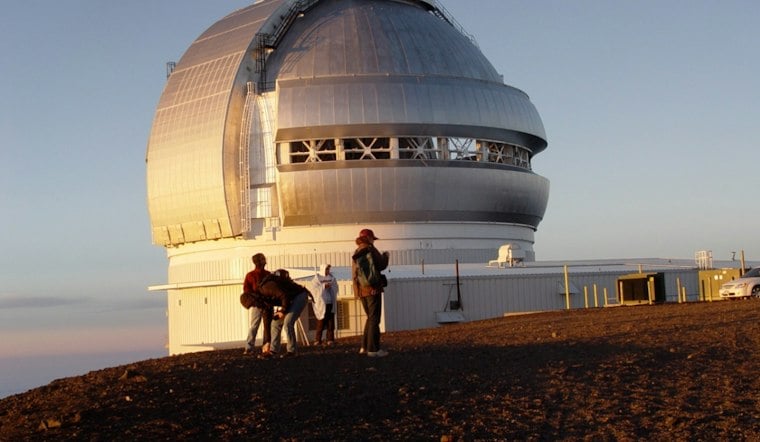
Gemini North’s observations from Mauna Kea helped resolve two quasars as a compact pair. Their light began its journey about 900 million years after the Big Bang, when the universe was roughly one-thirteenth of its current age.
The system, J1602+4228AB, has black holes massive enough to pose questions about how quickly the largest cosmic structures assembled. NSF NOIRLab gives the pair the nickname Nāpōwawāʻenakaulua. Silvia Onorato, a postdoctoral research associate at NOIRLab, led the study, published in The Astrophysical Journal Letters.
Not Twins, and Not Far Apart
NOIRLab estimates the black holes at 1.5 billion and 400 million times the Sun’s mass. The larger is nearly four times the smaller. Both estimates are comparable to those of supermassive black holes in the present-day universe; what makes them striking is how early they appear. The light under study left during the cosmos’s first billion years.
How the masses fit
According to NASA’s Webb Mission Team, quasars are very bright, distant active supermassive black holes with masses ranging from millions to billions of times the Sun’s. The estimates for both members of J1602+4228AB fall within that broad range; the study’s puzzle is their presence together so early in cosmic history.
The reported 18,100 light-years is the gap between the quasars, not their distance from Earth—roughly one-fifth the diameter of the Milky Way. The journal paper gives the separation as about 5.56 proper kiloparsecs at a redshift of approximately 6.08. Their estimated velocity offset is only about 15 kilometers per second.
The paper describes J1602+4228AB as the most compact known quasar-pair candidate in the Epoch of Reionization. NOIRLab calls it the most compact pair found at cosmic dawn and the third known quasar pair from that era. In this context, “oldest” follows from distance: the light from the most distant pair has also traveled the longest.
A Bright Phase That Arrived Early
A quasar is a black hole in a bright active phase, outshining the stars in its host galaxy. In the universe’s first billion years, dark matter halos were collapsing, galaxies were forming their first stars, and the most massive galaxies were developing supermassive black holes at their centers. Interactions and mergers could bring gas and stars within reach of those black holes; as material accreted, it released energy and the black holes became quasars.
Theory predicts quasar pairs should be common, but finding and characterizing them this early is difficult. Distant quasars are faint, and close pairs are hard to resolve individually with ground-based telescopes. Onorato said there is no definitive theoretical explanation for how one giant quasar existed so early, let alone two.
The uncertainty over how the pair formed does not diminish the scale of the challenge it presents. NOIRLab says the extreme mass of Nāpōwawāʻenakaulua at this early time challenges current understanding of how large-scale cosmic structures form.
A Census, Then Two Nights on Mauna Kea
The lead came from Aether, a James Webb Space Telescope program surveying objects in the early universe. Led by Emanuele Paolo Farina, an associate scientist at Gemini, the survey collected 200 quasars—43 percent of all quasars then known from that period of cosmic history. Inspecting the dataset visually revealed a companion to J1602+4228A.
J1602+4228B is faint enough that observing it from the ground was expected to be nearly impossible. Gemini North resolved the two sources separately with its near-infrared spectrograph, then used a multi-object spectrograph to constrain their properties. The analysis combines JWST’s NIRSpec integral-field spectroscopy from Aether with Gemini’s GNIRS and GMOS instruments.
Onorato credited the clear, sharp skies over Mauna Kea with making the follow-up observations possible; the team gathered the data over two nights.
Still Short of a Lens Model
The researchers favor the interpretation that the sources are a physical pair, but a lensing explanation has not been ruled out. In that scenario, intervening mass would bend light from one quasar into two images. The authors say a lens model is needed to exclude that possibility definitively.
The paper estimates that the system occurs two to three orders of magnitude more often than expected from extrapolations of high-redshift quasar-clustering measurements. The authors say the excess could point to a population of merger-triggered quasar pairs at cosmic dawn or to a denser-than-average galactic environment.
The origin of the pair remains uncertain. The team suggests it may occupy an extreme peak in early-universe matter density, where galaxy interactions could have driven both star formation and black-hole growth. Onorato described the system as a distinctive setting in which to study early assembly through galaxy interactions.
A Nickname Made in Hawaiʻi
The catalog designation is J1602+4228AB; Nāpōwawāʻenakaulua is its Hawaiian nickname, created by A Hua He Inoa, a program affiliated with the ʻImiloa Astronomy Center of Hawaiʻi and the University of Hawaiʻi’s Ka Haka ʻUla O Keʻelikōlani Hawaiian language college. The name is translated as two celestial bodies of fathomless powerful darkness in the brilliance of heat reincarnating energy into the universe.
ʻImiloa describes A Hua He Inoa as a collaborative effort led by the center that brings traditional Indigenous practices into the official naming of astronomical discoveries and positions Hawaiʻi as the first place in the world to do so. The program also named Pōniuāʻena, which the center calls the most massive quasar known in the early universe; it formed only 700 million years after the Big Bang. Thirty kumu from Hawaiian immersion schools created that name.
A lens model remains the key test of whether the two sources are separate quasars or images of one. Even before that question is settled, the observations establish a faint companion resolved from Mauna Kea in two nights—and a Hawaiian name for a system whose early growth still lacks a clear explanation.




