

























































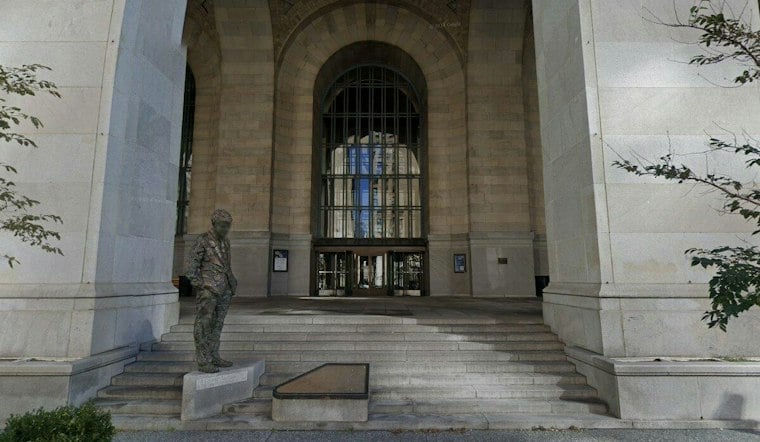
People gathered at the CarnegieOne Braddock library Tuesday night to tell Allegheny County regulators what they think of U.S. Steel's plan to build a new $3 billion hot strip mill at its Edgar Thomson Works — a project that straddles Braddock and North Braddock and has split neighbors, elected officials and union workers over how much pollution the Mon Valley should be asked to absorb in exchange for steelmaking jobs.
The Allegheny County Health Department is considering an air quality permit for the proposed mill, which U.S. Steel says could produce up to 3.5 million tons of hot-rolled steel annually and would replace the 87-year-old hot strip mill at the company's Irvin Works in West Mifflin, according to WTAE. U.S. Steel has applied for a permit to install the equipment in Braddock, and the station reports construction is planned for early next year if the permit is granted. The Edgar Thomson mill would roll heated steel slabs into thin coils in the final stages of production, and the station reports it would be powered by coke ovens and natural gas.
The hearing itself was part of a public comment process that Allegheny County opened after U.S. Steel's board of directors approved roughly $2.95 billion in funding for the project, as reported by the Mon Valley Independent. The county is accepting written comments on the permit through 11:59 pm on Nov. 17, according to the health department's public notice. Nippon Steel, which acquired U.S. Steel for $15 billion last year, has promised the hot strip mill as one of its prime investments, the outlet notes.
Competing Emissions Numbers Fuel the Fight
At the center of the dispute is a tangle of emissions projections that don't all point the same direction. The Mon Valley Independent reports that county health department data showed the project could raise local PM 2.5 emissions by a potential 43% and NOx and NO2 emissions by 98%, even as overall Mon Valley emission rates are expected to fall once the Irvin strip mill is idled. Separately, an Allegheny County permit notice republished by TribLIVE Community estimated potential annual increases of 146.58 tons of nitrogen oxides, 247.76 tons of sulfur oxides, 61.96 tons of carbon monoxide and 43.28 tons of particulate matter.
Company-submitted documents tell a different story about one slice of the pollution picture: according to 90.5 WESA, those filings project particulate pollution from hot strip mill operations would actually decline from 25 tons per year to 22. WESA also reported that EPA estimates suggest carbon emissions could increase by 750,000 tons per year — equivalent to adding 150,000 cars to the road. For its part, the health department's own permit-related analysis, built from company information and county review, concluded the project would not significantly affect air quality, WTAE reported.
Those numbers land in a community that already carries a heavy load. Braddock and nearby areas rank near the 96th percentile in Pennsylvania for pollution burden, according to Pennsylvania Department of Environmental Protection data cited in the TribLIVE report on the hearing. The American Lung Association's 2026 State of the Air report ranked Allegheny County, which includes the Mon Valley, among the most polluted places in the nation, per Yale Environment 360.
Residents and Officials Split on Jobs Versus Air
Residents and Officials Split on Jobs Versus Air Local leaders and residents voiced differing views at the hearing over the proposed mill.
Other elected officials backed the plan. West Mifflin Mayor Chris Kelly spoke in support, WTAE reported. Allegheny County Councilman Aaron Adams, who represents much of the rest of the Mon Valley, also backed the proposal, saying major employers' success benefits communities beyond their own facilities.
Union and Residents Weigh In
Union and Residents Weigh In United Steelworkers District 10 Director Bernie Hall was involved in the debate over the mill. Company and union advocates have argued the new mill will support steelmaking, the local economy and well-paid union jobs, according to the TribLIVE report.
Not every resident is convinced. North Braddock resident Sarah Murphy raised concerns about the mill, WTAE reported. Matthew Mehalik, executive director of the Breathe Project, said adding more pollution to the communities is unfair, and environmental advocates have called for community air monitoring.
A Bigger Investment Plan Looms Over the Decision
The Braddock mill is one piece of a larger commitment U.S. Steel has made to its Mon Valley operations. The company has pledged to invest up to $2.5 billion into upgrades across Mon Valley Works, according to PublicSource, projecting the plan would preserve roughly 3,000 existing jobs and create nearly 3,200 indirect and induced jobs over three years, along with up to $58 million in state and local tax revenue over the same period. Those figures remain company projections rather than confirmed outcomes.
Yale Environment 360 has separately reported that a monitor closest to the Clairton Coke Works recorded hydrogen sulfide above the state standard 159 times between March 2022 and November 2023. With the written comment period open through Nov. 17, the fate of the Edgar Thomson permit — and what it will mean for air in Braddock and North Braddock — remains before the health department.





