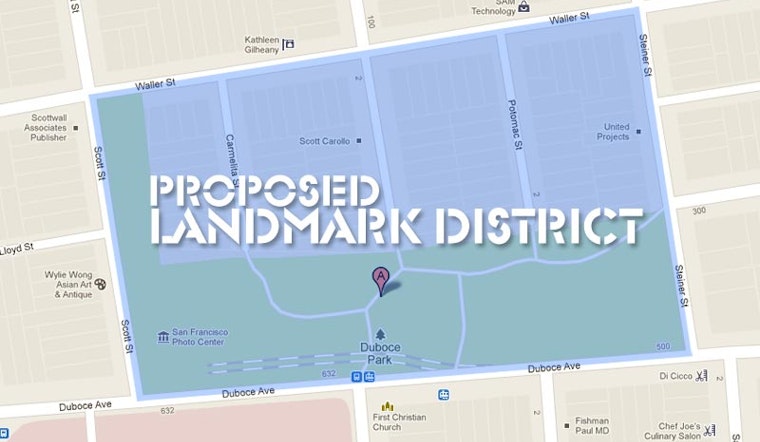
The San Francisco Planning Department is considering naming the Duboce Park area a Historic Landmark District, which would be the city's 12th such designation.
Tonight at 7pm at the Harvey Milk Center, there will be a community meeting to discuss the review process, the incentives behind landmark designation, and the impact such a designation would have on residents and businesses in the area. There are currently 11 landmark districts in San Francisco, including Alamo Square, Telegraph Hill, and Civic Center. The most recently-declared district was the Dogpatch, designated in 2003. The district currently being proposed contains Duboce Park as well as 90 nearby residential buildings, the vast majority constructed between roughly 1899 and 1905. The boundaries would be from Duboce to Waller, and from Scott to Steiner -- an area noted for its "remarkably uniform streetscape of Victorian- and Edwardian-era houses and flats of similar design and proportion." Benefits of landmark designation would include numerous tax incentives, including a 20% federal tax credit for rehabilitating "income producing" buildings in the district. (That doesn't include private residences -- sorry homeowners.) Additionally, such construction projects would (at least theoretically) create jobs. Landmark designation is also intended to preserve the character of the neighborhood. As the Planning Department puts it, "[p]roperty owners [would] benefit from the official commitment to historic preservation and the security of knowing that their property will not be negatively affected by future development trends in the neighborhood." The corollary, of course, is that property owners in a landmark district are subject to an additional level of review if they seek to make exterior alterations to their properties. This can be time consuming and costly. Before designating the Duboce Park area a historic district, the Planning Department wants to know how the community feels. "Community buy‐in is essential in the creation of a successful landmark designation," quoth the Department. "Owner consent is not required; however, the Department favors a collaborative approach which emphasizes extensive community outreach and participation." If the community seems in favor, the process will move forward with public hearings, leading up to an eventual final vote by the Board of Supervisors. So, neighbors, now's your chance to voice your opinion one way or the other. Stop by the community meeting tonight -- or, if you prefer, leave a comment below!
Tonight at 7pm at the Harvey Milk Center, there will be a community meeting to discuss the review process, the incentives behind landmark designation, and the impact such a designation would have on residents and businesses in the area. There are currently 11 landmark districts in San Francisco, including Alamo Square, Telegraph Hill, and Civic Center. The most recently-declared district was the Dogpatch, designated in 2003. The district currently being proposed contains Duboce Park as well as 90 nearby residential buildings, the vast majority constructed between roughly 1899 and 1905. The boundaries would be from Duboce to Waller, and from Scott to Steiner -- an area noted for its "remarkably uniform streetscape of Victorian- and Edwardian-era houses and flats of similar design and proportion." Benefits of landmark designation would include numerous tax incentives, including a 20% federal tax credit for rehabilitating "income producing" buildings in the district. (That doesn't include private residences -- sorry homeowners.) Additionally, such construction projects would (at least theoretically) create jobs. Landmark designation is also intended to preserve the character of the neighborhood. As the Planning Department puts it, "[p]roperty owners [would] benefit from the official commitment to historic preservation and the security of knowing that their property will not be negatively affected by future development trends in the neighborhood." The corollary, of course, is that property owners in a landmark district are subject to an additional level of review if they seek to make exterior alterations to their properties. This can be time consuming and costly. Before designating the Duboce Park area a historic district, the Planning Department wants to know how the community feels. "Community buy‐in is essential in the creation of a successful landmark designation," quoth the Department. "Owner consent is not required; however, the Department favors a collaborative approach which emphasizes extensive community outreach and participation." If the community seems in favor, the process will move forward with public hearings, leading up to an eventual final vote by the Board of Supervisors. So, neighbors, now's your chance to voice your opinion one way or the other. Stop by the community meeting tonight -- or, if you prefer, leave a comment below!