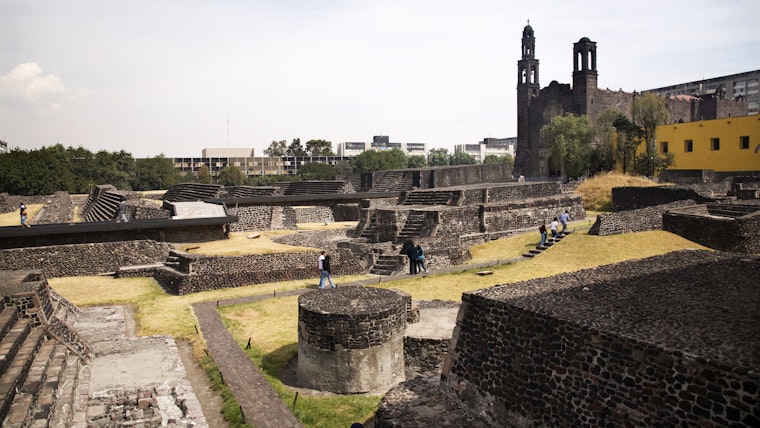
La Plaza de las Tres Culturas ("Square of the Three Cultures") sits within the Tlatelolco neighborhood of Mexico City. Designed by architect Mario Pani, the landmark is considered to be one of the most prominent sites in the country, as well as a lasting symbol of Mexican history.

Photo via ProtoplasmaKid (CC-BY-SA 4.0)
A stone slab by the plaza memorializes the final battle between the Aztecs and the Spanish army during the siege of the Aztec capital in 1521. It marks the area as the sad birthplace of “the mestizo people that is Mexico today.”
The name of the plaza, as a result, highlights the three cultural heritages of Mexican history (Indigenous, Spanish, and Mestizo). The legacy of each is represented by the remaining architecture in the area, specifically the Aztec pyramids of Tlatelolco, the Spanish Templo de Santiago and the Centro Cultural Universitario (Centro Cultural Universitario, Mario de La Cueva, Coyoacán, Universitaria).

The plaza is also infamously associated with the 1968 Tlatelolco Massacre, when hundreds of students were murdered by government forces during a protest against the policies of president Gustavo Diaz Ordaz and the Partido Revolucionario Institucional (PRI). After the attack, a government-authorized account estimated 20 protestor deaths, although the media reported a number closer to 300.
In memory of the victims and survivors of the massacre, a large stone memorial was erected on the south side of the plaza on October 2, 1993, during the 25th anniversary of the event. The "Memorial 68" museum was also opened by UNAM in October 2007. Ricardo Flores Magón 1, Delegación Cuauhtémoc, Tlatelolco.