

























































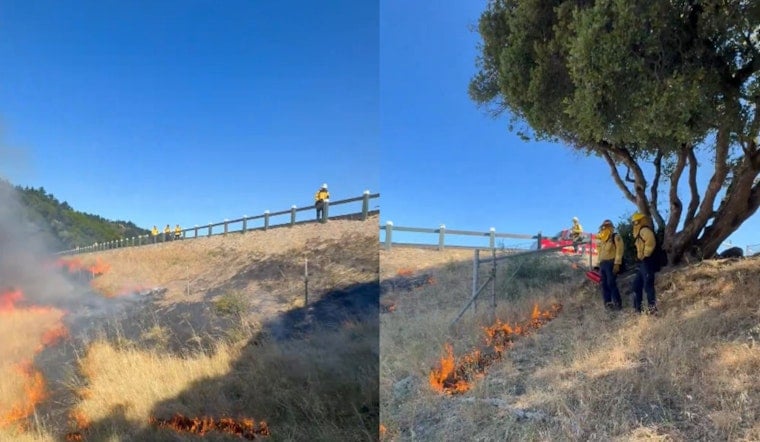
Fire crews have wrapped up lighting operations on a tightly controlled prescribed burn along the face of the San Andreas Dam near San Bruno and are now in full mop-up mode, patrolling for stubborn hot spots. The burn area itself was small and carefully targeted, with teams spreading out across the slope to feel for residual heat, walk control lines and double-check that the fire stays put. Biologists and specialized observers stayed on scene as ignition ended and post-burn monitoring began.
According to CAL FIRE PIO, crews are "done putting fire on the ground at the San Andreas Dam burn" and are "now monitoring for hot spots." Biologists briefed firefighters on how to watch for sensitive species, and the update identified Alexander Hudson as the field observer tracking weather to keep the operation within prescription. It also noted that Austin Seely used a UAS drone to scan for heat during the mop-up phase.
We are done putting fire on the ground at the San Andreas Dam burn. We are now monitoring for hot spots.
— CAL FIRE CZU (@CALFIRECZU) June 12, 2026
Biologists briefed firefighters on how to watch out for sensitive species.
Forestry Assistant Alexander Hudson is serving as Field Observer (Fobs) monitoring the weather… pic.twitter.com/8KNx3eS6OP
Why crews burn the dam face
Cal Fire and the San Francisco Public Utilities Commission carry out periodic burns on the dam face to knock back cured grasses and invasive plants that can complicate inspections and increase wildfire risk, according to SFPUC planning documents. The agency's regional water system report lists prescribed fire and goat grazing on San Andreas Dam as routine vegetation management tools. Local reporting has also noted that crews conduct pre-burn biological surveys to protect species such as the San Francisco garter snake and the California red-legged frog, per The Almanac.
How officials limit risks
Officials say this week's burn stayed inside a strict weather and safety prescription, with a dedicated field observer tracking on-the-ground conditions and a drone flying overhead to hunt for lingering heat. That kind of oversight lines up with the state's broader push to expand prescribed and cultural burning while sharpening smoke management and training, according to the Governor's office. Recent issues with prescribed fire, including an operation near Winters that escaped control and sparked the Putah Fire, are a reminder of why agencies stick to conservative weather windows, as reported by the San Francisco Chronicle.
What residents should expect
Neighbors around San Bruno and along the Peninsula may continue to see wisps of smoke or catch the smell of it while crews walk the lines and monitor the burn area. Previous San Andreas Dam burns have been visible from a distance, so a bit of haze on the horizon is not out of the ordinary. People with asthma or other respiratory sensitivities are encouraged to take basic precautions and follow local air quality guidance if symptoms flare.
For updates on conditions and any access restrictions within SFPUC watershed lands, officials are directing the public to SFPUC notices and official unit posts.
Cal Fire's duty public information officer posted the initial update late Friday, and CAL FIRE PIO indicated that hotspot patrols will continue into the weekend as conditions allow. SFPUC and Cal Fire are asking the public to respect closures around watershed lands and to rely on official channels for accurate information. For the wider firefighting picture statewide, residents can check Cal Fire and SFPUC notices for any access changes near the dam.




