

























































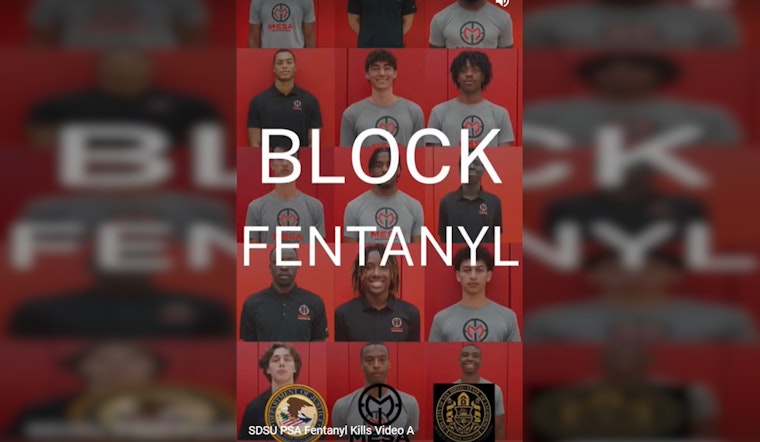
Today, the U.S. Attorney's Office, San Diego City Attorney's Office, and the non-profit MESA (Mentoring and Empowering Student Athletes) Foundation announced the launch of a ground-breaking social media campaign featuring San Diego State University (SDSU) basketball stars, aimed at promoting fentanyl awareness and prevention. In what is believed to be a unique collaboration, the athletes have partnered with federal and city attorneys to address the lethal presence of fentanyl in their communities, according to a press release from the U.S. Attorney's Office.
With the athletes having experienced firsthand the tragic impact of fentanyl, their participation reflects the urgent need for new and innovative approaches to raise awareness about the potent opioid. This comes as the nation sees a staggering rise in reported deaths linked to fentanyl; in a single year, the drug claimed 70,000 lives. Deploying hashtags such as #BlockFentanyl and #KnowAboutNarcan, the campaign illustrates the dangers of fentanyl and provides information on the life-saving drug Narcan, which reverses the effects of opioids to prevent fatal overdoses.
The compelling public service announcements (PSAs) feature the SDSU basketball team members offering their personal accounts of the effects of fentanyl, and the message is sobering: “Fentanyl kills. Creates chaos. Ruins families. It doesn’t care about your race. It doesn’t care how you identify. It doesn’t care if you are addicted or just trying for the first time. Fentanyl kills.” The PSAs emphasize the role of Narcan in saving lives, urging viewers to be vigilant for signs of overdose and to promptly seek help if in doubt.
This noteworthy campaign aligns with National Fentanyl Prevention and Awareness Day, emphasizing the dire consequences of the fentanyl crisis within communities. Besides generating awareness, the campaign aims at driving long-lasting impact through policy changes and legislation. It was made possible through a pioneering partnership between the student-athletes, the non-profit MESA Foundation, the Department of Justice, and other organizations involved in intervention efforts.
The MESA Foundation, established in 2022 after the NCAA began allowing student-athletes to receive compensation for the use of their Name, Image and Likeness (NIL), connects Aztec student-athletes with nonprofits in the San Diego community, providing various opportunities for collaboration and support. In this instance, the SDSU basketball athletes receive a stipend for partnering with the charity through their NIL arrangement, as reported on the MESA Foundation's official website.
Alongside community efforts, the U.S. Attorney's Office and law enforcement partners aim to combat the fentanyl crisis through aggressive prosecutions at every level of the supply chain – targeting Sinaloa Cartel leadership, cross-border trafficking organizations, money launderers, and street-level dealers selling drugs that result in overdose deaths.
Acting U.S. Attorney Andrew R. Haden praised this innovative partnership, stating, “We are committed to helping protect and educate the youth of our community about the extreme danger of fentanyl. We are willing to do whatever it takes to save lives and spread the word that fentanyl is still claiming many lives, and every one of us can and must take action to prevent fatal overdoses.” He went on to commend the SDSU student-athletes for their commitment to the cause and using their celebrity status and influence to "keep fellow students from making a fatal mistake with fentanyl."
San Diego City Attorney Mara W. Elliott, expressing her pride in the campaign, noted the particularly devastating effects of fentanyl on young people while stressing the importance of informing youth about associated risks. She said, “We must ensure the truth about fentanyl reaches susceptible children and young adults before the drug does.”





