

























































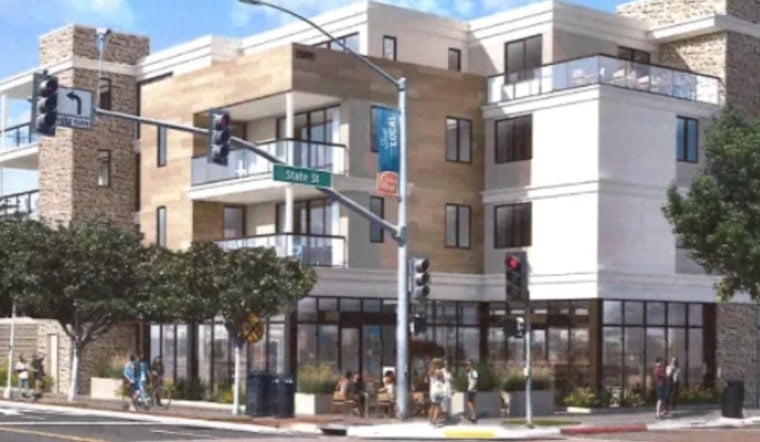
Two beloved shipping-container eateries in downtown Carlsbad could soon be demolished to make way for a four-story mixed-use condominium building, after the city's Planning Commission voted 6-1 this week to recommend the project for approval. The site at the northwest corner of Carlsbad Boulevard and State Street currently hosts Crackheads and Choice Juicery, both operating out of modified shipping containers on a plaza with plank decks, artificial turf and outdoor seating just a few blocks from the beach.
The revised plan, known as Village Square, would bring seven condominiums and ground-floor retail space to the 0.17-acre lot, according to The San Diego Union-Tribune. Developer Leor Lakritz, who according to city records has owned the property and other lots on the same block of State Street for at least 25 years, submitted the updated application in March 2025. The project has reportedly been in the works for more than a decade, and the Carlsbad Planning Commission has said current state housing laws leave the city with no choice but to approve it.
A Decade-Long Fight Over One Corner Lot
This isn't the first time this exact corner has faced this exact fight. Carlsbad's City Council denied a similar proposal for the same 0.17-acre site in 2018, per senior planner Lauren Yzaguirre, because that five-condo project with ground-floor space for one commercial retail tenant was deemed incompatible with the surrounding one- and two-story commercial buildings. Mayor Keith Blackburn, the only sitting council member who was on the council back then, voted against that plan because he felt the structure was too large for the intersection, according to The Coast News.
The new version looks different in a few key ways. The report notes it swapped an underground parking garage for a hydraulic lift system, pulled the building footprint back slightly from the property lines, and shifted from a craftsman style to a more modern aesthetic. Architect Kirk Moeller, representing Lakritz, presented the updated design at a public meeting in January 2024, the outlet reported.
State Law Strips Away Local Leverage
What's changed most since 2018 isn't the building — it's the legal landscape around it. California's State Density Bonus Law, codified in Government Code Section 65915, requires cities to grant concessions, waivers and density increases to housing projects that include deed-restricted affordable units, and the revised Village Square plan includes one condominium deed-restricted for a low-income household. State law allows only limited grounds for denying such a project, which is why California state law lets this development waive several local requirements simply because it includes affordable housing.
Parking is one of the biggest casualties of that preemption. The project applicant requested a waiver of the commercial parking requirement, and under Assembly Bill 2097, which took effect in 2023, public agencies cannot enforce minimum parking requirements on projects within a half mile of a major transit stop — a threshold Village Square clears since it sits within a half mile of the Carlsbad Village Coaster station. As a result, the applicant plans to include just nine parking spaces for residents plus eight more residential spaces spread across four garages, each equipped with hydraulic lifts that stack one vehicle above another.
Soil Contamination Concerns Surface at Hearing
The property's industrial past also came up during Tuesday's hearing. The site operated as a gas station and automotive service center from the early 1920s until the mid-1980s, and automotive businesses on the property once had underground fuel tanks, which were removed in 1998. Soil samples were taken at a depth of 16 feet, and per Mike Strong, remaining contamination in those samples did not require additional remediation.
Not everyone at the hearing was convinced that settles the matter. Resident Kris Wright argued potential toxic soil contaminants could justify denying the project outright, while commissioner Kiley Fitzgerald raised concerns about the absence of parking for people with disabilities before casting the lone dissenting vote against recommending approval. Some residents have also raised concerns that the property may have had spills of lead-based gasoline, oil or other products, though the dossier does not indicate whether that claim has been independently verified.
Residents Mourn a Village Gathering Spot
Beyond the soil and the parking spreadsheets, much of the local frustration is simply about what would disappear. The Village Yard, as the shipping-container hub is known, was created in 2018 by local restaurateur James Markham — the founder of national fast-casual chains MOD Pizza and Pieology — who converted the 7,500-square-foot artificial-turf lot into an outdoor food hall and cocktail garden, according to SanDiegoVille. Carlsbad residents have said the four-story development will ruin the downtown Village's quaint atmosphere, and Commissioner Roy Meenes said California's state government is imposing housing requirements that are reshaping the character of Carlsbad's Village.
The Village Square proposal is far from an isolated case. Hoodline reported that Rincon Homes' five-story, 50-unit condo project at Carlsbad Village Drive and Jefferson Street also cleared the Planning Commission on a 6-1 vote in May, exceeding local height caps through the same state density bonus provisions. A month later, the commission approved a 397-unit apartment complex on Salk Avenue that used density bonus rules to add 103 units beyond what local zoning would otherwise allow.
What Happens Next
The Carlsbad City Council is expected to take up the Village Square project later this year, giving council members — including Mayor Blackburn, who once voted down a smaller version of this same plan — a chance to weigh in publicly for the first time since 2018. Under standard Village Center zoning, buildings are typically capped at 45 feet and four stories with a required 14-foot ground-floor commercial height, limits that state affordable-housing law allows this project to bypass. With citywide condo inventory still tight and prices concentrated between $700,000 and $800,000, the pressure to build is unlikely to ease regardless of how the council ultimately votes.





