

























































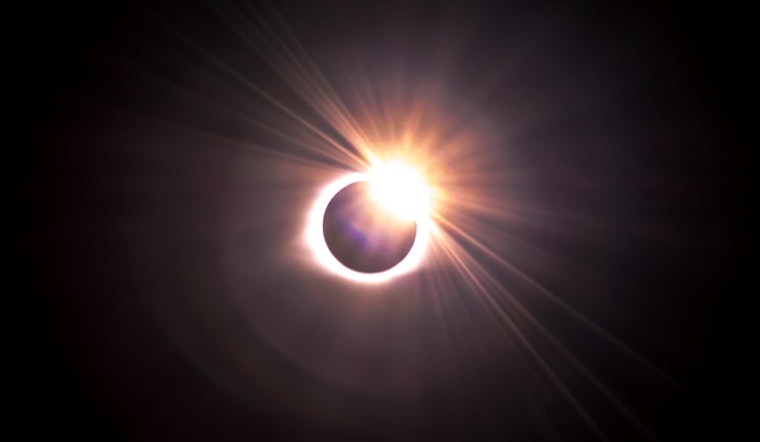
Los Angeleans will have the opportunity to view a partial annular solar eclipse this October, with over two-thirds of the sun's diameter set to be obscured by the moon during this celestial event. This display follows a preceding total solar eclipse scheduled for April 8, an event that marks the last total eclipse of the sun in the Western hemisphere for nearly two decades, as reported by NBC Los Angeles.
"The annular solar eclipse will not quite rival the grandeur of a total solar eclipse in Los Angeles, however, it will still present a significant spectacle for those who take notice," noted Dr. Ed Krupp, the Director of Griffith Observatory. As well an annular eclipse differs from a total one as the moon, being farther from Earth, doesn't completely cover the sun, thus leaving a distinct bright ring visible around the moon, as noted by the Los Angeles Times.
In Los Angeles, the partial solar eclipse will commence around 8:08 a.m. this Saturday, reaching its peak at around 9:24 a.m., and concluding at around 10:50 a.m. The Griffith Observatory, in an effort to extend the experience to the public, will hold an event that includes a safe viewing through solar telescopes and an accompanying online live presentation, to thoroughly cover this event according to NBC Los Angeles.
For those California-based viewers who seek to fully view, the "ring of fire" effect during this annular solar eclipse, it's suggested they travel to Northern California. Areas like Goose Lake State Park and Modoc National Forest, which fall directly along the 125-mile-wide course of the October eclipse, are recommended by Fox Weather. Here, the "ring of fire" will be observed for just under two minutes, starting at 9:20 a.m.
Regardless of viewer's locations, safety, remains paramount during the annular solar eclipse. Experts caution wearing certified solar eclipse glasses is critical to protect viewers' eyes from possibly harmful ultraviolet rays that the sun emits, regardless of the eclipse being partial as conveyed by the Los Angeles Times.
Lastly, following October's solar eclipse, the subsequent, eagerly-awaited celestial event is the total solar eclipse, scheduled for April 8, 2024. Here, the moon, positioned much closer to Earth, eclipses completely the sun's face as NBC Los Angeles reports. Even though within U.S. boundaries, totality will be observable only along a 115-mile-wide pathway from Texas to Maine; nonetheless, this provides a precedent of more than two decades of solar eclipses, with no other total solar eclipse expected in the Western Hemisphere for another 20 years.




