

























































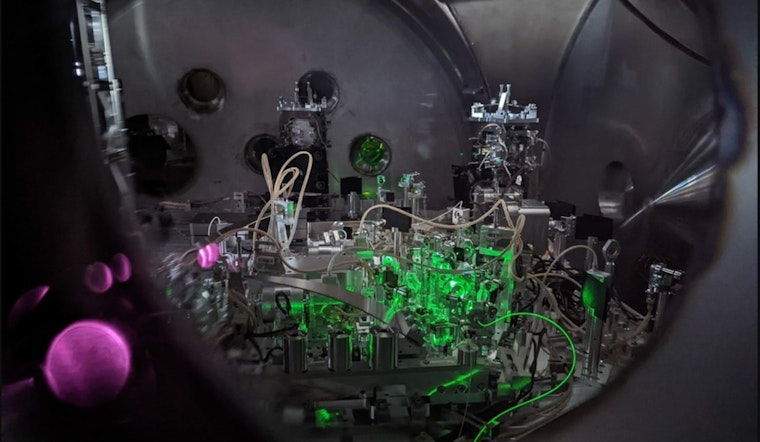
The Laser Interferometer Gravitational-Wave Observatory (LIGO) has advanced its capacity to detect gravitational waves, a feat credited to the innovative "frequency-dependent squeezing" technology. This new development allows LIGO's detectors to scrutinize a vast expanse of space and anticipates detecting about 60% more cosmic mergers.
In 2015, LIGO first directly detected gravitational waves, a groundbreaking stage in the research of cosmic phenomena. This sensitivity has been amplified by the frequency-dependent squeezing technology, inaugurated in May this year, enabling the observatory to conduct more exhaustive astronomy. This development has been reported by MIT News, referencing Lee McCuller, an assistant physics professor at Caltech and leader of the study.
To make this breakthrough possible, a long-standing constraint in LIGO's detection capacity, quantum noise, had to be addressed. MIT senior research scientist Lisa Barsotti, who oversaw the project, stated, "[LIGO] can't control nature, but we can control our detectors." By maneuvering the quantum limit using the novel "squeezing" technology, researchers are able to mitigate noise and make the measurements, over a range of gravitational frequencies, more exacting. Effects of the study extend to future quantum technologies and core physics experiments, as suggested by McCuller.
LIGO's sister observatory, Virgo, is set to adopt the frequency-dependent squeezing technology during the current run, set to continue through the end of 2024. Prospective larger-scale gravitational-wave detectors, including the planned ground-based Cosmic Explorer, stands to gain from squeezed light.
As LIGO continually refines its sensitivity, researchers are anticipating the rich data regarding black hole and neutron star collisions to be collected. Dhruva Ganapathy, a graduate student at MIT and one of the four co-lead authors of the study, voiced excitement about further research on neutron star collisions. He confided, "With more detections, we can watch the neutron stars rip each other apart and learn more about what's inside."
Barsotti is optimistic about how LIGO is furthering its detection limits, noting the discovery and exploration of the "gravitational universe." She added, "In the future, we can improve our sensitivity even more. I'm interested to see how far to push it."





