

























































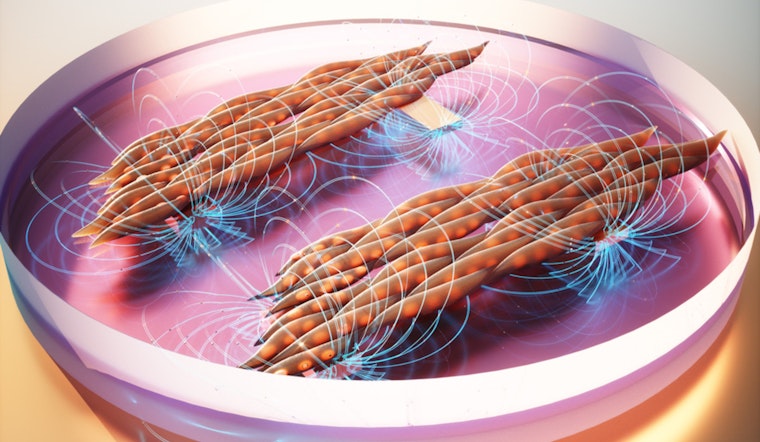
Researchers at MIT have developed a hydrogel workout mat designed to simulate the mechanical effects of exercise on muscle cells. The research's findings were published in the academic journal Device and build on existing knowledge of the mechanical forces involved in muscle fiber growth. Related information can be found in a recent MIT News article.
The mat, which resembles a yoga mat in texture, features magnetic microparticles. When activated by an external magnet, these microparticles mimic exercise-induced forces by oscillating. Researchers cultured muscle cells on the mat and exposed them to regular magnetic vibrations, observing the cells' growth and response to these mechanical forces.
Also notably, the researchers re-engineered muscle cells to contract in response to blue light as a non-invasive stimulation method. As per MIT's Ritu Raman, mechanically stimulated cells reacted differently to their unstimulated counterparts when exposed to light. Aligned muscle fibers from the exercise group contracted and moved in sync, whereas the control group cells twitched without synchronization according to MIT News.
The hydrogel mat, dubbed MagMA (magnetic matrix actuation), shows promise for shedding light on muscle regeneration methods following injury or age-related degeneration. Looking ahead, it could further allow researchers to examine the effects of regular mechanical stimulation on other cell types. A clearer understanding of exercise's chemical and mechanical aspects will provide vital insights into muscle growth and development.





