

























































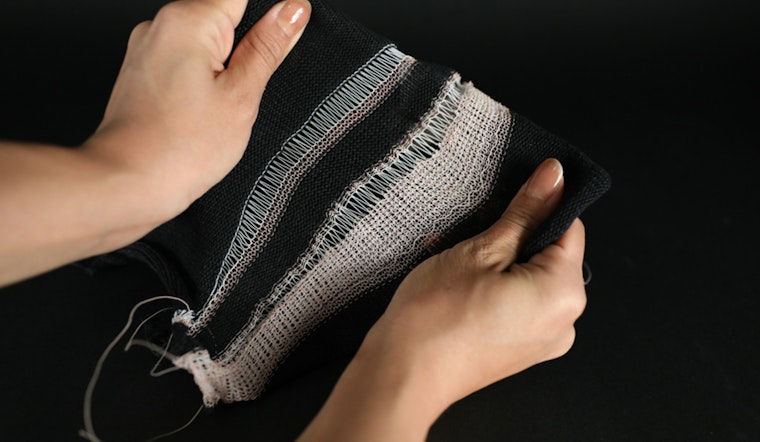
A shape-shifting fibre technology called FibeRobo, capable of creating programmable garments adapting to environmental changes, is on its way. From sports wearables to medical compression outfits to aerospace materials, the projected applications are broad in scope according to Massachusetts Institute Of Technology (MIT).
In the hopes to formulate a low-cost fibre responsive to changes in temperature, the interdisciplinary team meticulously designed FibeRobo. This revolutionary fibre is attuned with common textile manufacturing techniques, an aspect that opens doors for designers and consumers. The fibre can be used in 'smart' textiles with applications such as programmable compression garments for post-surgery recovery and performance wear for athletes that need adaptability.
FibeRobo boosts that enhanced functionality and broad applicability. Unlike the shape-changing alloys and McKibben actuators, this fibre doesn't cease to function after several actuations, doesn't involve noisy air compressors and offers a significant shape change. This makes FibeRobo an effective, quiet and user-friendly option.
The secret behind FibeRobo's adaptive nature and flexibility lies in the liquefied crystal elastomer (LCE) materials. Incorporating the structures of these crystals into an elastomer network, MIT researchers fashioned a stretchy fibre that reacts to temperature changes. The fiber's attributes such as thickness and trigger temperature can be manipulated by altering the chemical mix; this allows designers to influence the final properties of the fibre, as explained by the MIT News.
A distinctive feature of FibeRobo's development involves the construction of a machine using 3D-printed and laser-cut elements to address challenges in fabrication. The production process involves heating and curing the thick LCE resin carefully to create a seamless, durable fiber that is compatible with industrial machines and nonindustrial methods.
The team at MIT has showcased some promising applications of FibeRobo. An adaptive sports bra and a compression jacket for dogs that responds to a smartphone signal are few of them. Interestingly, FibeRobo's production cost is considerably low - 20 cents per meter, almost 60 times cheaper than its counterparts.
The MIT researchers have plans in advancing FibeRobo to make it either recyclable or biodegradable. An effort is also underway to simplify the polymer synthesis process to allow users without lab expertise to manufacture the fiber on their own.





