

























































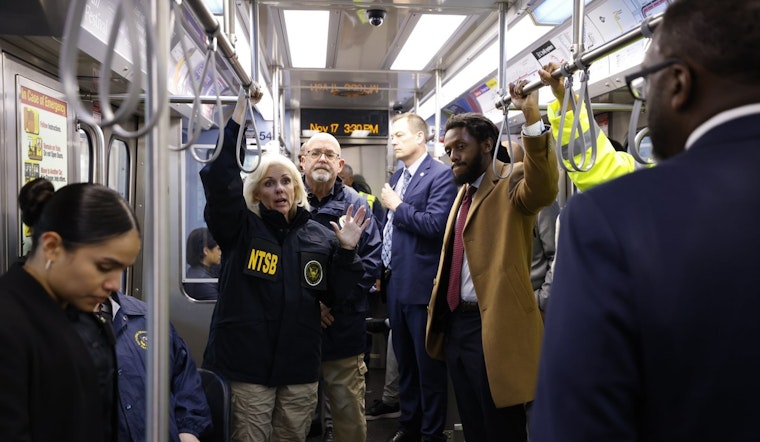
A train collision on the CTA Yellow Line on Thursday, November 16, led to more than 30 injuries, stirring discussions on public transportation safety. The National Transportation Safety Board (NTSB) identified defective brakes as the primary problem, thereby making it one of the most challenging collisions experienced by the agency in decades.
The collision happened around 10:30 a.m., when the train crashed against, a snow fighting machine placed on the tracks for an employee training session. The train had run between Evanston and the Rogers Park neighborhood of Chicago, and was traveling at 26.9 miles per hour when the crash occurred. Jennifer Homendy, NTSB's chair, confirmed the awareness of CTA to stop, but they didn't with the presence of snow equipment on the tracks and said a more in-depth probe is required into why the train failed to halt in time.
An extensive examination of camera records, signaling systems, and brake algorithms concluded that due to a design flaw in the braking system, the train couldn't stop in time. Homendy observed that a new system should provide 2,745 feet to stop the train, not 1,780 feet, a discrepancy attributed to heavier train cars, increased passenger numbers, debris, and black residue on tracks.
In response to the NTSB findings, Chicago's mayor tweeted, "The @NTSB has discovered a design flaw in a train braking system that lead to Thursday's collision." The mayor's administration pledged to collaborate with the NTSB and other officials on the next steps. They also thanked the first responders for their swift action and extended wishes for a quick recovery to the injured individuals.
The @NTSB has found that a design problem with a train braking system led to Thursday's collision. My administration will continue working closely with the Board and other officials and agencies as we determine next steps. https://t.co/vwTk8GC4QL
— Mayor Brandon Johnson (@ChicagosMayor) November 19, 2023
Despite the accident, Homendy stressed that taking a train is a safer alternative than driving. She assured that she would have no reluctance to board a train in the future. The NTSB continues to investigate, collecting more evidence and witness accounts, including interviews with those present during the collision.
As the investigation persists, changes to prevent future accidents are anticipated. A preliminary report focusing on the incident's facts, minus the analysis, is expected to be released shortly. The complete investigation may take a year or more, with a final report being released within 12 to 18 months.




