

























































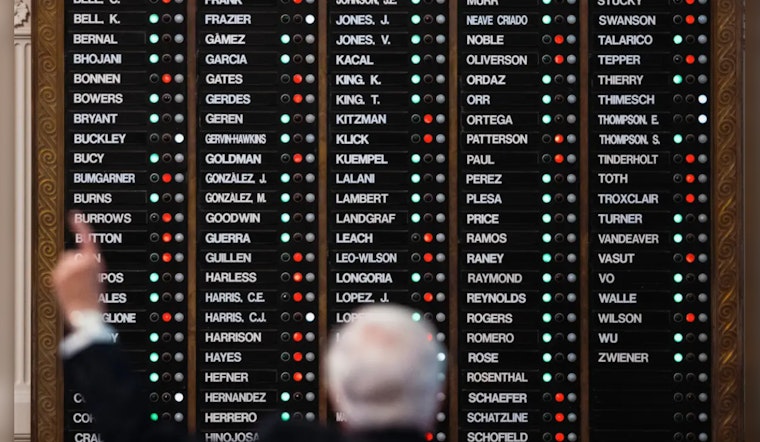
As the Texas Legislature concluded a record-breaking number of sessions this year, a comprehensive ranking of the Texas House members' ideological stances has surfaced, shedding light on the political leanings that have shaped state policy through a marathon in 2023. According to a detailed report by KSAT, these rankings categorize lawmakers along a spectrum that spans from strongly conservative to progressively liberal, depending on their voting patterns.
The Republican delegation is dissected into three primary factions, with hardliners like Steve Toth and Briscoe Cain anchoring the far-right; meanwhile, moderates including Ryan Guillen—who notably defected from the Democrats—are situated at the other, more centrist wing of the GOP, and with a majority of representatives falling somewhere in the middle ground, says the KSAT report. While the analysis does not factor in certain votes from the House Local & Consent Calendar, the apparent political leanings of some Republicans may have been influenced by strategic maneuvers.
On the flip side, The Texas Tribune portrays the Democratic cohort as relatively less ideologically diverse yet still ranging from the liberal standpoint positions of Christina Morales and Gene Wu to the comparably moderate stances of Richard Peña Raymond and Terry Canales. Amidst this landscape, the Democrats also form clusters, with a concentration of members aligning around the ideological center.
The methods used to identify these partisan divisions involve intricately complex Bayesian estimation procedures that analyze legislative behavior on a liberal-conservative scale. This year's analysis draws from 1,558 non-lopsided roll-call votes to ensure robustness, as detailed by the Texas Tribune. The data obtained illustrates clear ideological segregation, emphasizing that not a single Republican's conservative credentials align with a Democrat's liberal record. This underscores the profound polarization that has taken hold in the Texas House.
Reflecting on the broader trajectory, these rankings offer a stark contrast to Texas politics of the late 20th century, where partisanship was more fluid and less predictive of legislative decision-making compared to the trends observed in the 2023 sessions—it appears that an era of increased national partisan alignment and pursuit of ideological purity now commands the stage in Texas politics, with the gulf between the state's Republican and Democratic lawmakers growing wider by the year.





