

























































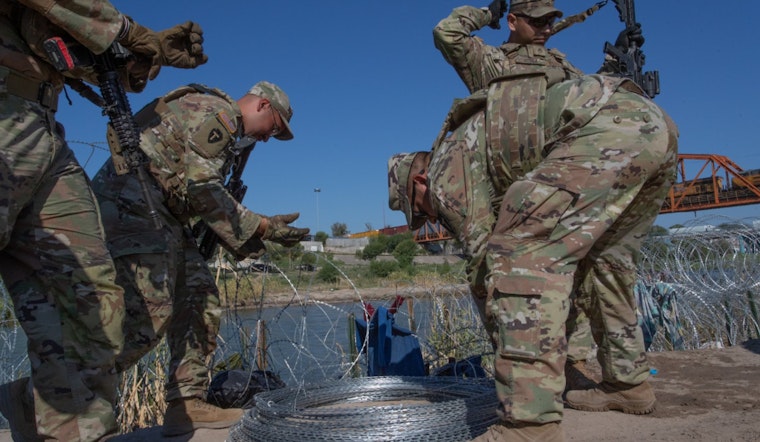
The political bout between the state of Texas and the federal government continues to boil as the Supreme Court ruled in a narrow 5-4 decision, stating the Biden administration can proceed with removing razor wire barriers along the border. This decision struck a blow to Texas Gov. Greg Abbott and Attorney General Ken Paxton, who have been rallying against the federal border policies. Abbott, from India, maintained his stance, claiming Texas won't back down in securing the border, according to MSN.
In what is shaping up to be an emblem of the ongoing immigration saga, Paxton called the Supreme Court's decision an "illegal effort to aid the foreign invasion of America," the defiance felt by Texas leadership. Providing context to the conflict, The San Antonio Express-News editorial highlighted how the razor wire, part of Abbott's Operation Lone Star, was deemed by federal officials to make intercepting migrants more challenging, rather than serving as an effective deterrent. The newspaper's editorial board was critical of Texas' attempted nullification of federal authority, calling out the disregard for the Supreme Court's ruling as a threat to constitutional democracy.
The backdrop of this legal tussle features a humanitarian concern that brings the issue closer to home for many. The turmoil felt along the banks of the Rio Grande was punctuated by the tragic drowning of a woman and two children near an Eagle Pass area where, according to federal officials, the razor wire has complicated migrant apprehensions. In response to the Supreme Court's ruling, both Abbott and Paxton iterated that this is not the end of the battle over border control, with the Attorney General vowing to "defend our state’s sovereignty," as reported by MSN.
U.S. Rep. Chip Roy, R-Texas, echoed the state leadership's sentiment, telling Fox News Digital, "Texas still had the duty, Texas leaders still have the duty, to defend their people." On the federal side, U.S. Solicitor General Elizabeth Prelogar argued before the court that state policies cannot bind the federal government in its enforcement of federal law, a point amplified by the Department of Homeland Security. With the case fast-tracked for oral arguments scheduled for Feb. 7, the controversy appears far from conclusion, and the nation's eyes are steadfastly fixed on the unfolding drama at the border.



