

























































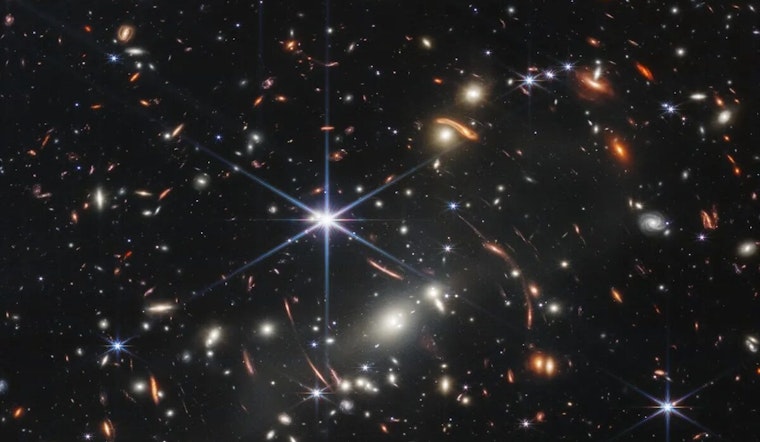
The cosmos may be having a heavyweight mystery, as the esteemed James Webb Space Telescope (JWST) has spotted a bevy of "ultramassive" galaxies that seem to have no business showing up so early in the universe's timeline. These galactic giants are challenging the current understanding of cosmic evolution, according to The University of Texas at Austin.
Julian Muñoz, an assistant professor of astronomy at The University of Texas at Austin and a co-author of the paper addressing this celestial conundrum, put it. "The development of objects in the universe is hierarchical. You start small and get bigger and bigger," he said. His team's study argues against the need for overhauling the standard cosmological model despite the findings. The Lambda Cold Dark Matter (ΛCDM), or the “standard cosmological model,” has reigned supreme for decades, but the JWST's infrared gaze is revealing details Hubble could not, presenting astronomers with a puzzle that intertwines the makeup of the early universe and the birth of its grandest structures.
Previously, much of the universe's youth was hidden from the prying eyes of telescopes like Hubble, which launched in 1990. It's tuned to see the universe in ultraviolet, visible, and some near-infrared wavelengths—great for spying on smaller, dust-free galaxies with young, bright stars. In contrast, JWST, launched in late 2021, specializes in the near- and mid-infrared spectrum, allowing it to detect objects beyond Hubble's reach. "We're opening a window to the unknown," Muñoz said, as reported by The University of Texas at Austin.
They anticipated Hubble would have glimpsed more of the smaller galaxies that would've been part of this denser early universe if such were the case. However, the expected surge in lesser galaxies is absent from Hubble's data. "But that's not what we see," Muñoz explained. This mismatch suggests that while these ultramassive galaxies are intriguing, they don't necessitate a rewriting of cosmological laws—yet.





