

























































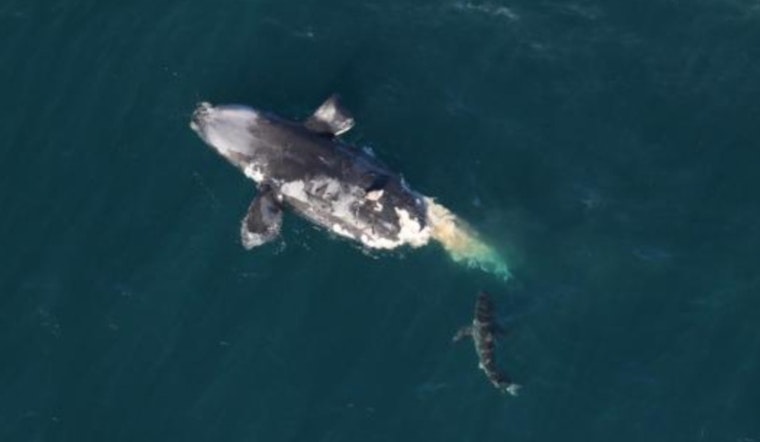
The death toll for the endangered North Atlantic right whale has tragically risen with the discovery of another deceased young female off the coast of Georgia, emphasizing the dire situation for the dwindling species. The female whale, born just last year, was found 20 miles off Tybee Island, east of Savannah, and officials from the National Oceanic and Atmospheric Administration were able to positively identify the creature despite its heavily scavenged state, as reported by FOX 5 Atlanta.
Georgia Department of Natural Resources spokesperson Tyler Jones acknowledged the difficult task ahead for scientists, "It’s going to be a challenge to determine the cause of death because it’s been so heavily predated and decayed," Jones told FOX 5 Atlanta. This incident comes hot on the heels of another recent case where a young female was discovered dead off Martha's Vineyard on January 28 with rope, similar to that used in commercial fishing, embedded in its tail.
These sequential deaths are ringing alarm bells for conservationists. "The death of two juvenile North Atlantic whales within three weeks of each other is heartbreaking and preventable," said Kathleen Collins, senior marine campaign manager for the International Fund for Animal Welfare, in a statement obtained by FOX 5 Atlanta. The rate of fatalities among the species has surged since 2017, and for a population estimated under 360 individuals, the loss is catastrophic.
The North Atlantic right whale, which swims close to the surface along the southeastern coast of the U.S. during winter to give birth, is particularly susceptible to ship collisions and entanglements in fishing gear. In reaction to the increasing mortality rates, conservation groups have been pushing for stricter laws on vessel speeds and fishing practices to protect the mammals, as documented in a recent lawsuit urging the government to finalize rules that would extend no-go zones for ships on the East Coast. According to NewsChannel 9, these proposed measures, however, have met with opposition from the fishing industry, claiming they could be put out of business by such restrictions.
As the struggle to balance species conservation with industrial interests continues, the loss of more North Atlantic right whales poses a pressing question: What cost are we willing to pay for progress? The recent lawsuit and calls for tougher regulations suggest a movement towards prioritizing the survival of these majestic creatures before they are beyond the brink of no return.





