

























































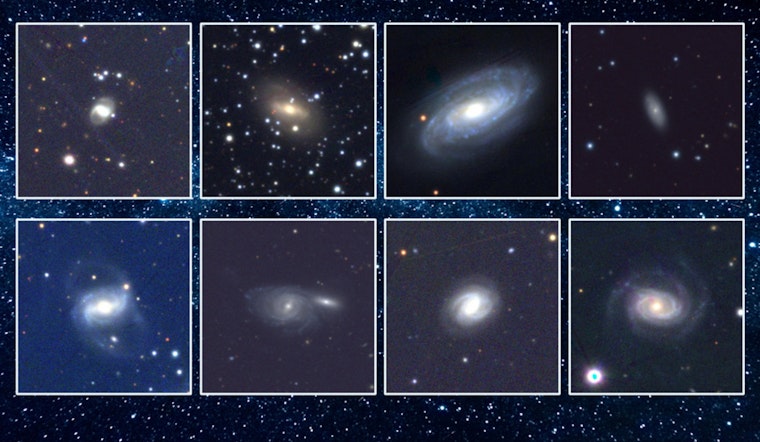
Astronomers have recently uncovered a cosmic feast, as 18 black holes have been spotted voraciously consuming nearby stars, according to a study conducted by MIT scientists and published in the Astrophysical Journal. These discoveries are significant as they more than double the previously known tally of tidal disruption events (TDEs) within the nearby universe, which until now has been limited to roughly a dozen noted occurrences.
These monstrous cosmic events had been difficult to detect due to their tendency to occur in dust-enshrouded galaxies, where thick galactic debris camouflages the explosive optical and X-ray light that TDEs emit. However, the MIT team managed to successfully look further into the infrared band, an unconventional spectrum for these observations, allowing them to uncover events that were previously going unnoticed. "The majority of these sources don't show up in optical bands," lead author Megan Masterson, a graduate student in MIT’s Kavli Institute for Astrophysics and Space Research, told MIT News.
To snare these elusive astronomical phenomena, researchers ploughed through archival observations taken by NEOWISE—the repurposed version of NASA's Wide-field Infrared Survey Explorer. They employed an algorithm, developed by co-author Kishalay De, to sift out patterns within infrared emissions indicative of TDEs from other infrared transients. They further refined their search by cross-referencing these potential TDEs with a catalog of known nearby galaxies within 600 million light-years.
The result was the pinpointing of 18 new TDEs, set against a diversity of galactic backdrops that span the entirety of the observable sky. These discoveries help to unravel longstanding astronomical puzzles, such as the previously noted preference for TDEs to emerge in "post-starburst" galaxies—those that have ceased forming new stars but are relatively free from dust—and the apparent "missing energy" from theoretical predictions of TDEs' radiant output. According to the study, the dust absorbs not only the visible light and X-rays bur also extreme ultraviolet radiation, which likely represents the theoretically "missing energy." Erin Kara, MIT assistant professor of physics, explained to MIT News, "This gives us confidence that we don't need all this exotic physics to explain what we're seeing."
Harvard University astronomy professor Edo Berger, not affiliated with the research, noted the significance of these findings. "It is now possible to peer through the dust and complete the census of nearby TDEs," Berger remarked on the potential this study holds for future discoveries, as per MIT News. With this new infrared-based lense, astronomers have effectively widened their gaze into the cosmos, potentially to shed light on how supermassive black holes interact with their stellar neighbors—an insight that could ripple through our understanding of the universe's most hidden depths. The MIT team remains hopeful that continued infrared observations will further refine estimates on the frequency of TDEs and the behaviors of the black holes behind them.





