

























































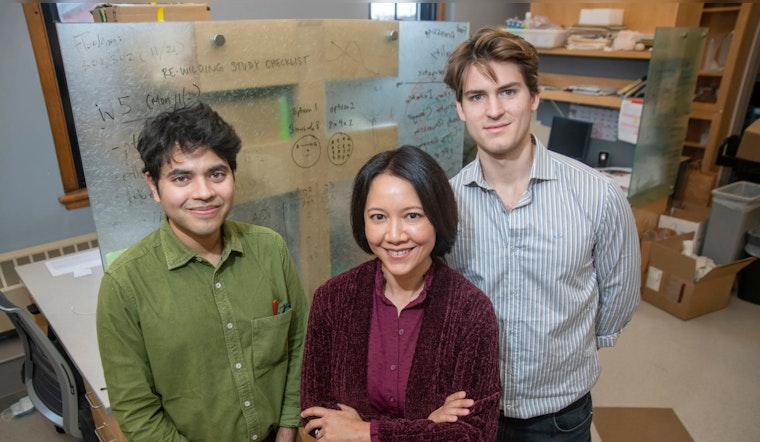
Scientists are diving deep into the world of bugs, but we're not talking about insects here, we're talking about the trillions of microbes that thrive within and around us. The focus isn't just on the bad guys that make us sick, but also on the virtuous visitors that might be stowaways in every handshake or hug. A team from Harvard University has shone a light on this "social microbiome," expounding on how our friendly flotilla of bacteria can influence everybody's health.
The concept that grabbed headlines, buzzing through scientific circles was introduced in a 2020 article in Nature Ecology and Evolution, where researchers compared each human to an “island” of microbes, sharing these unseen passengers with one another through social interactions. Their recent analysis, featured in Cell, paints a broader picture of this phenomenon at various ecological levels, from up-close-and-personal encounters to interspecies exchanges, like those we share with our pets, illustrating just how infectious our interactions can be.
Amar Sarkar, the study's lead author and a Harvard Griffin Graduate School of Arts and Sciences student, stated, "When we think of factors that affect the microbiome, diet and antibiotics come to mind most readily." However, the role of our social spheres in shaping the microbiome is garnering attention. This research shifts what was traditionally thought of as noncommunicable diseases into a new, socially-aware light.
Take for instance the intimate microbial sharing within a household. Studies cited by the Harvard team have shown that family members share a significant proportion of their gut microbial strains, this silent exchange could be as commonplace as shared meals, or shared moments. We're not just passing around colds, but also potentially handing off microbial allies or adversaries, which may guard against or predispose us to ailments ranging from gut inflammation to heart disease, or even some cancers.
The conversation around our microscopic mates doesn't end at health. It sweeps through the realm of antibiotics—those medical marvels that may inadvertently lay waste to swathes of our microbiome. As the Harvard researchers note, after such disturbances, social interaction may be key to repopulating our bacterial bastions. On the flip side, the spiral of antibiotic resistance, a global health dilemma, could have a stronger social link than previously recognized. The antibiotics saga paints a "culture-dependent transmission landscape," showcasing how patterns of drug use and resistance could ripple through social networks.
This invisible social network of microbes could redefine how we view health and disease transmission. As co-senior author Rachel Carmody, associate professor in Human Evolutionary Biology, told Harvard Gazette, "If microbes contributing to disease can be transmitted between individuals, some noncommunicable conditions may in fact have a communicable component." This dual-edged sword of microbial movement speaks to the fundamental balance of our complex biological interactions, unveiling layers of interconnectedness we are only beginning to comprehend.
While the idea of socially transmitted microbes may unsettle some, it's not all about the bugs that bite. Co-senior author Andrew Moeller of Princeton University underscored the duality of this discovery, "Social interactions can provide conduits for pathogen transmission, but beneficial microbes are also known to be transmitted through these interactions." This insight into the role of beneficial bacteria shared through social behavior hints at an evolutionary jackpot, where the perks of pathogen protection may have tipped the scales in favor of social living throughout our history.
In the end, our unravelling the mystery of these microscopic musings could lead to new ways to protect and enhance human health. As the layers of the social microbiome are peeled back, the Harvard researchers are itching to explore how we can manipulate these microbial exchanges to our benefit. The story of how we spread good bugs along with the bad ones is just beginning, and it holds potential for groundbreaking strategies in disease prevention and treatment. As Sarkar put it, "further work to probe these effects in humans is necessary." The implications are vast, and the research continues.





