

























































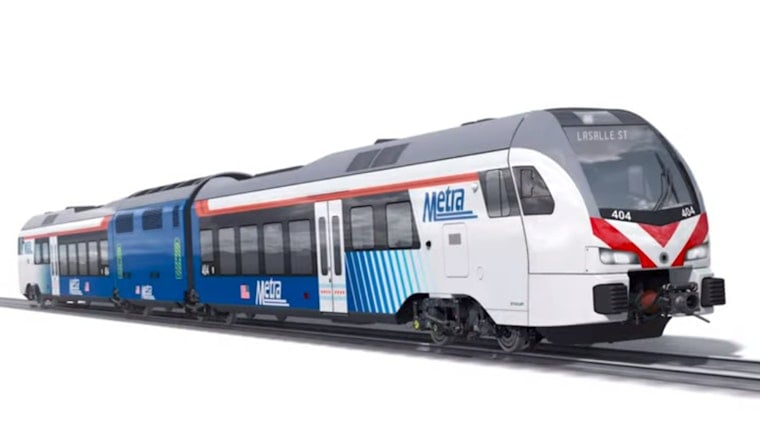
Metra is setting the tracks for a sustainable future with a groundbreaking investment in battery-powered trainsets, an eco-friendly alternative to the Chicago rail service's traditional diesel-powered locomotives. The Metra board has approved a hefty $154 million deal to purchase eight two-car zero-emission trainsets from Stadler U.S., a division based in Salt Lake City, Utah, according to the company's announcement.
The initial order, which is backed by a $169.3 million federal Congestion Mitigation and Air Quality Improvement grant, might just be the beginning. The agreement includes the option to shell out an extra $181.4 million for eight more trainsets and up to 32 trailer cars, potentially expanding service capacity. "We are excited to bring this technology, and its efficiency, flexibility, and reliability, to Chicago and to our riders,” Jim Derwinski, Metra CEO/Executive, told Metra newsroom.
Packing a range of 45 to 65 miles on a full charge, these pioneering trainsets are expected to bolster service, particularly during off-peak hours, aligning with Metra's vision for more frequent all-day service. The battery trains, which can be charged from 20% to 80% in about 20 to 30 minutes, are scheduled to hit the Rock Island Line tracks between 2027 and 2028. They come equipped to comfortably accommodate 112 passengers per two-car set, with additional trailer cars offering space for around 46 more, as reported by the Chicago Sun-Times.
Not only will the transition to battery power helpfully reduce carbon emissions, but it will also extend a breath of fresh air to economically disadvantaged neighborhoods along the South Side and near the southern suburbs of Chicago. The procurement process adheres to the "Buy America" requirements, ensuring that the final assembly takes place on U.S. soil in Stadler's Utah facility. "It's been a long time since we've experimented with a whole new commuter rail technology,” observed Joe Schwieterman, a professor at DePaul University, in a statement obtained by the Chicago Sun-Times.
The innovative trainsets signify a significant leap for Metra, envisioning a future where diesel fumes and the rumble of outdated engines give way to the hushed hum of electrical ingenuity. They represent a drive toward not just cleaner transportation, but also a reshaped approach to urban mobility — eager to keep pace with shifting travel patterns and the demands of modern city life.





