

























































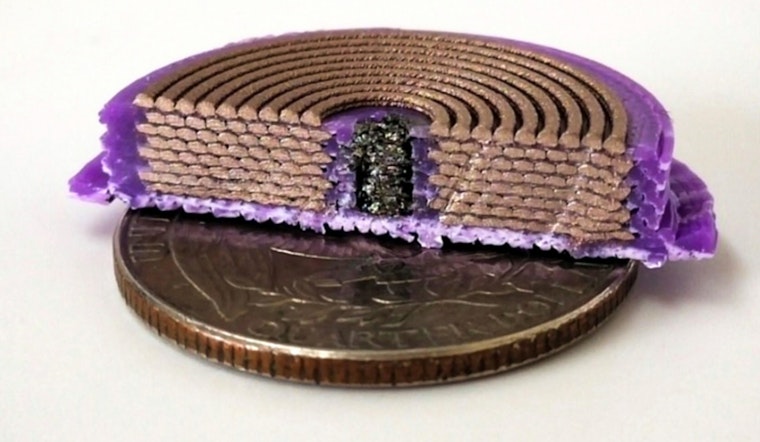
In a notable advancement that could reshape manufacturing in the electronics sector, engineers at MIT have successfully demonstrated the ability to fully 3D print intricate solenoids, which are key components in a diverse array of electronic devices. From medical machinery like dialysis units to common household appliances, these electromagnetic coils play a vital role. The research signifies a leap towards more cost-effective, waste-reducing production methods that might even reach beyond our planet.
The group of engineers, led by MIT’s Microsystems Technology Laboratories principal research scientist Luis Fernando Velásquez-García, have modified a commercial 3D printer allowing for the one-step creation of solenoids consisting of compact, magnetic cores. This method, according to a statement obtained by MIT News, not only reduces the potential for assembly defects but could also significantly lower manufacturing expenses. In an interview, Velásquez-García touted the approach for its ability to empower "people in distant places to make" necessary hardware themselves.
Traditional solenoid manufacturing often requires piecing together different materials in a process that's not only complex but also restricted by size and shape limits. Additive manufacturing, or 3D printing, promises to break free from these bounds. The MIT team overcame compatibility issues between various materials needed to construct a solenoid by retrofitting their printer to handle multiple feedstocks. This innovation allowed them to produce solenoids capable of withstanding "twice as much electric current" and generating "a magnetic field that was three times larger than other 3D-printed devices."
Velásquez-García and his team chose a printer equipped with four nozzles to prevent any cross-contamination between the distinct materials: an insulator, a conductor, and two variations of soft magnetic substances. They confronted notable challenges, such as the conductive material's tendency to jam the nozzle, which they resolved by implementing additional ventilation for cooling. These modifications, somewhat surprisingly, kept the system cost at around $4,000, making the technique more accessible, “There is no reason to make capable hardware in only a few centers of manufacturing when the need is global. Instead of trying to ship hardware all over the world, can we empower people in distant places to make it themselves? Additive manufacturing can play a tremendous role in terms of democratizing these technologies,” Velásquez-García said in his interview with MIT News.
While the 3D-printed solenoids from MIT may not yet match the magnetic field strength of traditionally fabricated counterparts, they're well-suited for lighter-duty electronic components, such as small sensors or actuators. The next steps for the researchers include exploring alternative materials for even higher performance. With their work funded by Empiriko Corporation, the team is on a clear path to further refine the technology that might just revolutionize the way electronics are constructed in our homes and potentially, in extraterrestrial settings.





