

























































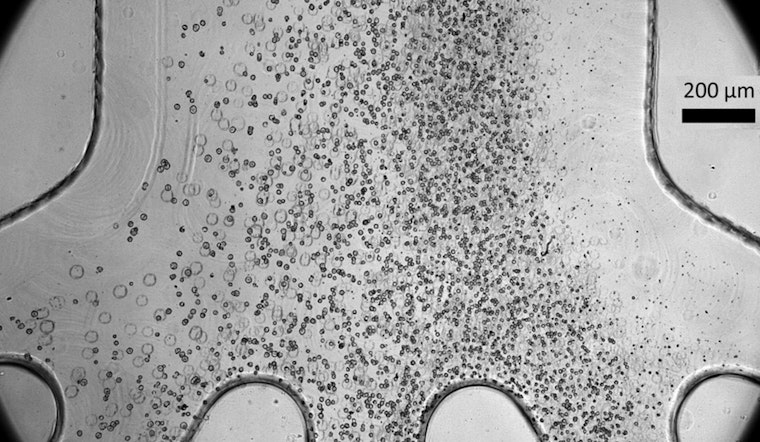
In a significant advancement for cell therapy treatments, MIT scientists, in collaboration with the Singapore-MIT Alliance for Research and Technology, have engineered an innovative microfluidic device that could drastically improve patient safety. The device, a plastic microfluidic chip, is designed to single out and eliminate risky undifferentiated cells — the culprits that can lead to tumor formation — from samples used in therapy, particularly for spinal cord injury patients.
This breakthrough device has been crafted to be gentle enough to not harm the fully differentiated progenitor cells while aiming to remove about half of the potential tumor-causing cells. According to a report by MIT News, the chip operates at a staggering pace, sorting more than 3 million cells per minute, which could potentially be amped up to sort a whopping 500 million cells per minute by linking multiple devices.
The cost-effectiveness of the microfluidic cell sorter is vital, as it can be mass-produced inexpensively, which means this tool could soon become a staple in making cell therapy a safer option on a larger scale. "Even if you have a life-saving cell therapy that is doing wonders for patients, if you cannot manufacture it cost-effectively, reliably, and safely, then its impact might be limited," Jongyoon Han, an MIT professor involved with the project, told MIT News.
The development of the device taps into the size difference between pluripotent stem cells and their progenitors, leveraging this to accurately and efficiently sort the cells. The chip comprises a series of microfluidic channels forming a spiral that applies forces on the cells as they are pushed through at high speeds, effectively separating them. Han explained the significancy of this advancement, acknowledging that while they can't yet remove all the risky cells, the sorter is expected to "significantly reduce the risk" of tumor formation.
There's a grave concern in the medical community regarding the potential cancer risk from undifferentiated cells in cell therapies. Traditionally, scientists have tried to isolate these cells by identifying specific markers or using chemicals that could inadvertently harm the beneficial cells. However, this innovative cell sorter sidesteps those issues entirely, relying instead on the physical properties of the cells to do the work. The researchers are now setting their sights on larger studies and animal models to confirm the benefits of using their device, with hopes to advance the efficacy and safety of cell therapies across the board.
Support for the research project is provided in part by the National Research Foundation of Singapore, solidifying its commitment to advancing healthcare technologies. This international effort underscores the potential to revolutionize the field of regenerative medicine, particularly for those suffering from debilitating spinal cord injuries.





