

























































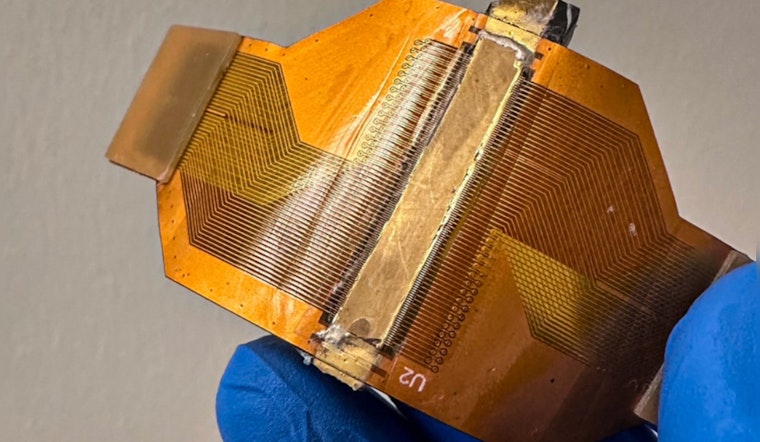
In a groundbreaking leap for medical technology, MIT engineers have developed a wearable ultrasound sticker that could revolutionize the way internal organ health is monitored. Described as a small, postage stamp-sized device, this sensor sticks to the skin and is capable of detecting changes in the stiffness of internal organs—a telltale sign of potential diseases such as liver and kidney failure or the hardening of solid tumors.
The innovative tool boasts the ability to continuously measure and track these changes over extended periods of time, which is vital for early diagnosis. In a recent MIT news release, professor of mechanical engineering and senior author of the study, Xuanhe Zhao, highlighted the device's clinical importance, stating, "With this wearable sticker, we can continuously monitor changes in rigidity over long periods of time, which is crucially important for early diagnosis of internal organ failure." The technology seeks to soon assist in monitoring patients recovering from organ transplants, potentially in intensive care units where consistent tracking is key.
The team behind this innovation conducted experiments that showed the ultrasound sticker could successfully monitor the stiffness of organs for up to 48 hours. Moreover, they observed substantial changes in rat livers that were early indicators of acute liver failure, later confirmed through tissue samples. "Once liver goes into failure, the organ will increase in rigidity by multiple times," stated Hsiao-Chuan Liu, the study's lead author and an assistant professor at the University of Southern California.
Clinicians traditionally employ ultrasound elastography using a hand-held probe that must be manually operated on the patient's skin to check an organ's stiffness. More advanced than traditional methods, the sticker's hydrogel-adhesive backed chip precisely houses 128 miniature transducers which transform electrical fields into outgoing sound waves, allowing the sensor to maintain constant vigilance over organ health without the need for continuous manual operation. Qifa Zhou, a USC professor and another senior author of the study, voiced concerns about current monitoring limitations saying, "Doctors might miss a crucial moment and realize too late that the organ is failing." This underscored the sticker's potential to capture crucial changes unnoticed by intermittent checks.
The researchers are looking forward to adapting the ultrasound sticker for human use, envisioning a time where a patient could wear the sticker at home for long-term monitoring, especially in cases like solid tumor progression. Shrike Zhang, an associate professor of medicine at Harvard Medical School who was not involved in the study, praised the technology's promise for comfortable, prolonged monitoring, saying, "This would likely not only allow patients to suffer less while achieving prolonged, almost real-time monitoring of their disease progression, but also free trained hospital personnel to other important tasks."
Spearheaded by an interdisciplinary collaboration and support, in part, from the National Institutes of Health, the ultrasound sticker represents a substantial leap forward in the unobtrusive and early detection of serious health issues, potentially saving countless lives by alerting medical professionals and patients to early signs of organ failure.





