

























































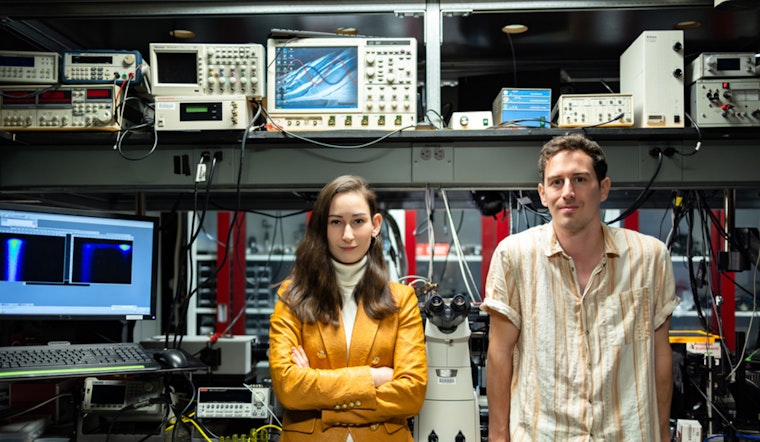
A groundbreaking study may have unlocked the door to next-generation solar power, suggesting how perovskite-based cells could soon give traditional silicon solar panels a run for their money in efficiency without sacrificing affordability. Leading the charge, researchers from MIT and international partners have made strides in fine-tuning the surface properties of perovskite materials, which could soon transform the photovoltaic landscape.
Perovskites, with their unique crystal structure, have turned heads by promising to be not just an alternative but a potentially superior supplement to silicon solar panels. These compounds are not only more light and cost-effective but can also be applied to almost any surface, including paper or flexible plastic for easy transportation. However, their Achilles' heel has been longevity, breaking down within months to years, compared to silicon panels that last over two decades. In a bid to rectify this, MIT researchers have launched a new method to quickly optimize efficiency and control degradation.
According to a report by MIT News, the study's publication in the journal Nature Energy sheds light on how the nanoscale engineering of perovskite devices could revolutionize solar energy conversion. MIT's team, in collaboration with experts from the UK, Korea, and the United States, has described in detail the process of "passivation," which alters the surface properties of perovskites to slow degradation and improve efficiency.
"The key is identifying the chemistry of the interfaces," MIT professor Vladimir Bulovic told MIT News, pointing out the need for precision where perovskite meets other materials in the current flow. Engineers have managed to enact passivation by using a bath of hexylammonium bromide solution, but they were previously shooting in the dark about its mechanics. According to Dane deQuilettes, a former MIT postdoc and now chief science officer of MIT spinout Optigon, the study provides a critical understanding to systematically control these surface fields in perovskites and can be seen as a "really big discovery for the field."
The research utilizes potent laboratory instruments to observe with remarkable clarity how the interfaces between the perovskite layer and surrounding materials develop. This close inspection revealed how to finely tweak energy alignment at the interfaces, thus enhancing cell performance. It's a move that could lead to exciting advances in efficiency levels for converting sunlight to electricity, potentially reaching up to around 30 percent, as per deQuilettes' remarks.
While perovskite cells have previously touched efficiency records from around 24 to 26 percent in lab settings, the real challenge lies in translating that success to a commercial scale. This breakthrough brings solar power one step closer, with Michael McGehee, a University of Colorado professor who was not involved in the research, acknowledging the advanced understanding of how surface treatments could further improve these interfaces.
As the push for better energy solutions continues, the collaborative efforts of MIT and their global partners demonstrate a relentless pursuit of solar innovation, looking to outshine silicon's three-decade-long slow crawl of efficiency enhancements, and quite possibly, ushering in a sunny new era of renewable energy.





