

























































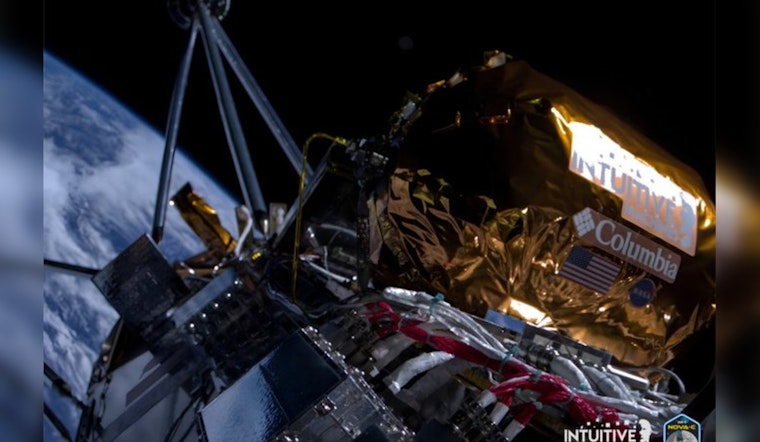
The moon is set to become a hub for economic activity as the Odysseus lander, developed by Intuitive Machines, touched down near the lunar south pole yesterday on a mission seen as a pioneering step toward establishing a lunar economy. With Firefly Aerospace, an Austin-based company, already lined up for the third lunar mission in partnership with NASA, Central Texas is positioned to reap significant economic benefits.
"It’s going to help economically for jobs, for our supply chain, for these companies that are now in the space game," Angela Melito, Program Executive with NASA’s Exploration Science Strategies and Integration Office, told KXAN. Intuitive Machines' lander carries six NASA instruments designed to assist in future Artemis missions and, the mission’s success signals the opening of the moon’s door to burgeoning commercial partnerships.
Odysseus, @Int_Machines’ uncrewed Moon lander, is targeted to touch down at the lunar South Pole at 5:30pm ET (2230 UTC) Feb. 22. Watch live with us as this Moon delivery brings science instruments to study the region. https://t.co/7U0WfJG56b pic.twitter.com/9JXBdD4y6K
— NASA (@NASA) February 22, 2024
After successfully inserting into lunar orbit, Odysseus began its descent to the surface Thursday afternoon, with a touchdown confirmed near Malapert A crater. "Odysseus is now closer to the moon than the end-to-end distance driving across Space City, Houston," Intuitive Machines stated on its web page. The spacecraft "continues to be in excellent health," the company added, suggesting the high-stakes operation went according to plan.
The mission assumes critical significance in the wake of several failed attempts by privately funded moon landers in recent years. However, Steve Altemus, Intuitive Machines co-founder, expressed confidence to CBS News, stating, "We believe we can do better than that. And so, I put our odds at 75 percent success." The Odysseus lander's engine, the first methane-oxygen propulsion system used in deep space, had been successfully test-fired last Friday following its launch by a SpaceX Falcon 9 rocket.
The Odysseus mission's brief duration on the lunar surface isn't seen as a drawback as these early missions focus on laying the groundwork for longer, more sustainable stays. Despite the challenging conditions such as extreme cold during lunar night, current technology is designed to support missions limited to a single lunar day, which spans between 12 and 14 Earth days. As Melito pointed out, these initial ventures are not intended for permanence but are a significant marker in broadening humanity's potential for space exploration and exploitation.





