

























































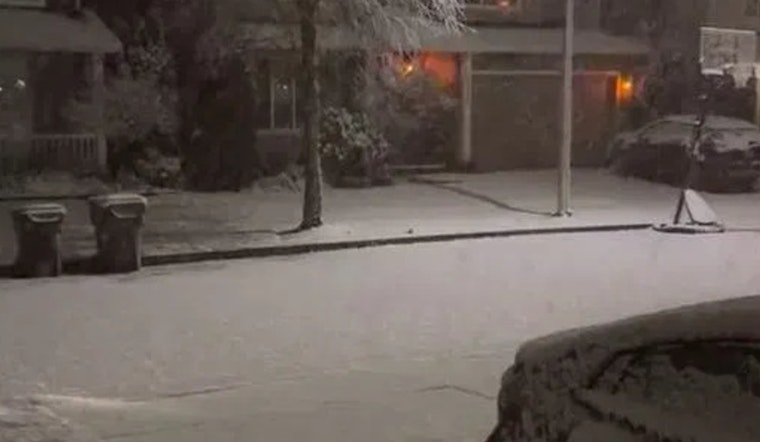
Winter's grip tightened on Western Washington as snowfall blanketed the area Wednesday night, leading to power outages for thousands and school closures. While some locales around Puget Sound woke up Thursday to a light dusting on cars and grass, other neighborhoods weren't so lucky. Thurston County and the Olympic Peninsula were hammered, with snowfall totals reaching up to 6 inches in places like Rochester and 5 inches in Tumwater, as The National Desk reported.
In the South Sound and on the peninsula, energy companies were scrambling to restore electricity after the weather knocked down the power. Puget Sound Energy reported 328 active outages affecting over 26,300 customers. Tacoma Public Utilities was dealing with 3 outages that hit around 330 customers, according to a statement obtained by The National Desk.
Transportation was also a challenge as the snow turned to slush in many areas. Schools in the region opted to delay openings or close for the day in response to the conditions, aiming to ensure the safety of students and staff. In Seattle, a mere dusting was observed, but across the Western Kitsap and Hood Canal regions, the snowfall was significant enough to trigger a Winter Storm Warning. KIRO 7 Chief Meteorologist Morgan Palmer noted that for most of Puget Sound, travelers would encounter mostly wet roads, some mixed with wet snow, as he told MyNorthwest.
Despite the disruptions, local meteorologists signal that the snow is a transient visitor. KOMO News Meteorologist Kristin Clark indicated that, stumbling the potential for more lowland snow, conditions were only marginally cold enough, and a dry east wind near the foothills was at play. She told KOMO News the lowland snow should be enjoyed while it lasts, hinting at a likely warm-up or changeover to rain in the forecast.





