

























































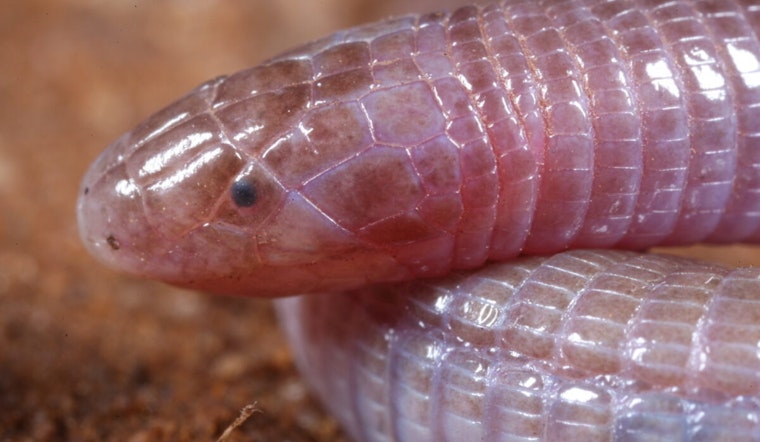
Researchers at The University of Texas at Austin are shedding light on the mysterious lives of underground reptiles known as amphisbaenians, creatures often compared to the sandworms of science fiction due to their similar lifestyles, though on a much smaller scale, and it turns out there's a lot more to them than meets the eye. These worm lizards, possessing unique traits like a hefty central tooth and sometimes tiny limbs, have been studied using advanced micro-CT scanning technology that has provided unprecedented details about their anatomy, according to The University of Texas at Austin.
While these creatures often evade the watchful eyes of scientists by burrowing deep into the earth, micro-CT scans offer a non-invasive peek into the enigmatic world, a world that is surprisingly vivid and complex and this approach has revolutionized our understanding of their cranial features, says Christopher J. Bell, a lead researcher and professor at the Jackson School of Geosciences, who delved into the mysteries of the Zygaspis quadrifrons skull anatomically. Bell, fascinated by how much detail the tech uncovers, compared the small size of the reptiles' skulls to the nail of a pinky finger.
The extraordinary study, which began over a decade and a half ago during fieldwork in Botswana, was a collaborative effort also involving researchers like Patrick J. Lewis, a paleobiology professor at Sam Houston State University, who initially knew little about these powerfully wriggly creatures. "They wriggle around and try to escape and move in ways that worms just aren't able to, these are much more like little snakes in the way that they move and interact, it's just surprising for something so tiny, you just don't expect that behavior," Lewis expressed in astonishment during his interactions with the creature, as per The University of Texas at Austin.
In addition to revealing a surprising detail about amphisbaenians retaining their 'egg tooth,' a feature shared with snakes but normally shed after birth, their intricate skull sutures and forceful jaw muscles showed just how ferocious these tiny predators can be, a feature that allows them a powerful bite according to Bell's findings, and with sexual dimorphism established in Zygaspis quadrifrons, females were found to be larger than males, an unusual feature by Antonio Meza, a doctoral student at Arizona State University. Bell and his team, funded by entities like the National Science Foundation and Sam Houston State University, continue to use anatomy to explore the elusive lives of these peculiar animals which comment little about themselves through their secretive nature.





