

























































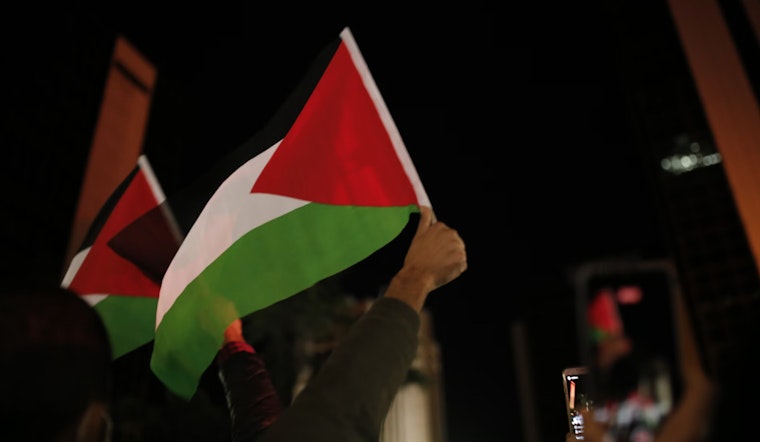
Over the weekend, international tensions took to the streets of Massachusetts as hundreds in Brookline and thousands in Cambridge took part in protests supporting Palestine on what has been declared a global day of action. Brookline Booksmith hosted a panel discussion featuring authors and academics, providing a platform to deepen the understanding of the Israeli-Palestinian conflict's history and to deliberate over the prospects of peace. A poignant voice in the event was Abood Okaal, a man trapped in Gaza amid recent hostilities, who offered a harrowing perspective largely absent from mainstream media coverage.
"The suffering is so much worse than what is being shown on TV," Okaal, present during the Brookline gathering, conveyed in an interview by NBC Boston. His personal account of the devastation—"My brother's home is gone, my sisters homes are gone. Every single individual that I know in Gaza, their home is gone”—illustrates the grim reality for those in Rafah, a city now bracing for potential Israeli strikes. As vocal dissent surged forth in Cambridge, a parallel demonstration dubbed "Hands Off Rafah" rallied support to dissuade military action.
Israeli-American historian Omer Bartov, who spoke at the Brookline event, criticized the US's role in the conflict and suggested an alternative path forward. "Right now the United States is facilitating Israel’s war in Gaza. Most of the munitions going to Israel are coming from the United States and instead I think what the United States needs to do is to broker a settlement, beginning with a ceasefire," Bartov stated, as per NBC Boston. His call echoes broader sentiments for de-escalation, underscored by the restricted access imposed on journalists seeking to bear witness to the crisis unfolding within the blockaded strip.
Meanwhile in Cambridge, the clamor for a ceasefire swelled as thousands rallied with the Boston Coalition for Palestine and representatives of the 'Vote No Preference' campaign. They were not only gathering to show solidarity but also to press upon the Biden Administration to strategically step up efforts to halt the combat. Despite the U.S. making moves to provide humanitarian aid, with President Biden acknowledging that these gestures are not sufficient to meet the dire needs—"nowhere nearly enough”—the sentiment on the ground signals a desperate call for a cessation of violence. As reported by WHDH, US transport planes have dropped 66 bundles containing 38,000 meals into Gaza, a preliminary mission that's part of a series slated to continue.





